
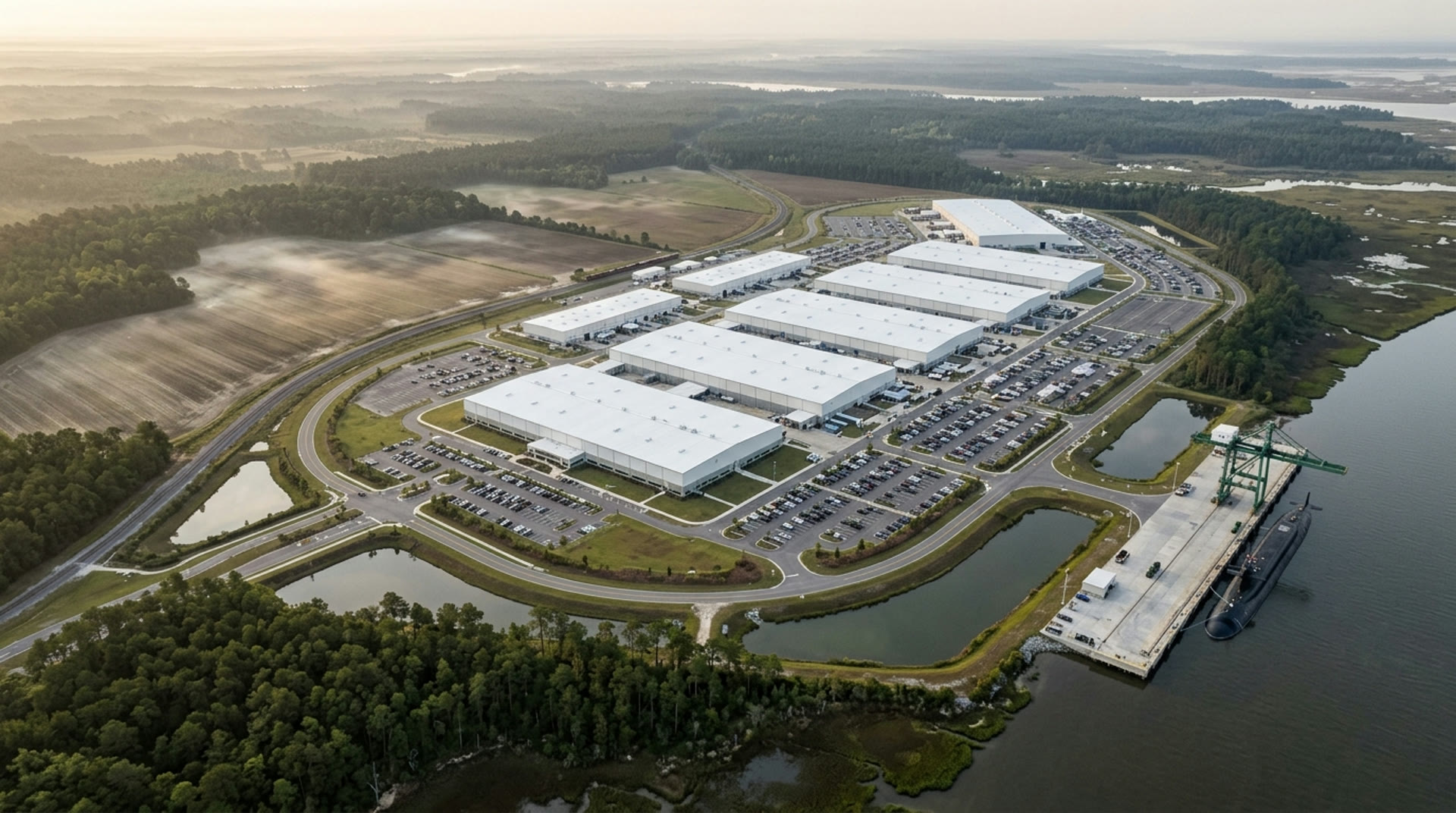
Forge · Port Wentworth, Chatham County, Georgia
Forge‑1
A new standard in defense manufacturing.
Planned facility · not yet built Site control Q3 2026 · Groundbreaking Q1 2027 · First article Q3 2028
Designed by Fantom
To be built in Georgia
FORGE-1
A new standard in defense manufacturing.
Concept rendering — the campus is not built. Every figure on this page is a design target, not a measurement.
Designed capacity
Ramp scheduleNone of these numbers has been built yet. They are the design targets FORGE-1 is being engineered and permitted against, and they are what we intend to hold ourselves to.
FORGE-1 is not a drone plant, and that is the whole problem. In the same year this campus will have to build a 4.1 lb hand-launched quadrotor and a 190-tonne submarine. Those two things share almost no manufacturing physics. What they share is a requirement to get out of the building. Designing for both from the start is cheaper than discovering the conflict after the slab is poured.
Why Savannah
LEVIATHANThe site selection started at the waterline and worked outward. We intend to build a 190-tonne submarine in the same campus as a 4.1 lb quadrotor, and a hull that cannot reach water cannot be delivered — so the first question was not land price or labour rate. It was depth at the fence line.
Eleven sites, nine weighted criteria, eight months. The finalists were west Chatham County, Mobile County, North Charleston, central Ohio and northwest Arkansas. That one criterion eliminated four of them before anything else was scored.
The honest part
What Ohio gets right
The inland finalist was a real contender and we scored it honestly. Steelmanned:
- A dense Tier-1 and Tier-2 aerospace supply base — GE Aerospace, Parker Hannifin, Timken, Honeywell — within a day's truck.
- Wright-Patterson ninety minutes away. Being able to put four engineers in a car and reach your program office before lunch is worth more than most people account for.
- Meaningfully cheaper land and construction.
- No named-storm exposure, and the insurance premium that goes with that.
- A 12,100 ft cargo runway with a freighter ecosystem already attached.
Four of those five we buy back. The supply base is two days by rail and one by truck, while our imported content travels four miles instead of seven hundred — net freight is roughly a wash. Customer proximity we solve with fourteen people resident in Dayton, permanently, at about $4.2M a year, which is cheaper than moving 5.4M ft². Land and construction cost us about $180M more, once. The runway we do not need.
The fifth thing — the insurance — we cannot buy back, and we did not pretend to.
Risk, priced
We are putting a plant on the coast
Georgia's landfall history is lighter than Florida's or the Carolinas' because the Georgia Bight recedes and most tracks recurve. Matthew in 2016 and Irma in 2017 both produced serious surge and wind here anyway. The record is not an argument, it is a sample.
| Structure | Risk Category IV for the assembly halls and the ledger hall — one category above code minimum — at a 150 mph 3-second gust |
|---|---|
| Elevation | Finished floor +19 ft NAVD88, above the 0.2%-annual stillwater plus 2 ft freeboard. No critical function below +16 ft. Site outside the FEMA VE zone. |
| Envelope | Roofs to FM I-175 uplift; no ballasted roofing anywhere on site. Impact-rated glazing on the occupied perimeter; no glazing below 25 ft on the halls. |
| Power | Two independent 230 kV feeds from separate substations, 30 MW dual-fuel standby, 12 MWh storage — sized to finish an in-progress autoclave cure and shut down cleanly |
| Doctrine | 96-hour condition ladder. Hulls float out or go to hard tie, cranes stow and pin, WIP moves inboard, a 60-person ride-out crew stays. |
| What it costs | $9–14M/yr in property and business-interruption premium over an inland equivalent, and an expected 3–5 lost production days per decade against six days of finished-goods buffer |
That is the whole ledger on hurricanes. We will pay nine to fourteen million a year and lose four days a decade, in exchange for being able to ship a hull at all. We would make the same trade again.
Inside the forge
FORGE OSTen buildings, 5.4 million square feet, one quality system — as designed. The bays are laid out in the order the product will flow, not in the order the buildings would be cheapest to finance.
| 01 · Air final assembly | 1,150,000 ft² — WRAITH FAL-A1 and A2 pulse lines plus a surge line held at 40% for FMS and attrition reconstitution |
|---|---|
| 02 · Effects & small systems | 780,000 ft² — POLTERGEIST, BANSHEE, SHADE, SPECTER and DEADFALL bodies. Inert. No energetics on this site. |
| 03 · Marine assembly hall | 900,000 ft² — LEVIATHAN and STYX. 400 ft clear span, 90 ft under hook, two 150 t bridge cranes certified for a 255 t tandem lift after derate |
| 04 · Composites & additive | 620,000 ft² — six AFP/ATL gantry cells, two 60 × 20 ft autoclaves at 400 psi, a 48-machine LPBF farm, DED for titanium near-net preforms |
| 05 · Electronics & REVENANT integration | 520,000 ft² — SMT, box build, ISO 7 cleanroom, and the trusted assembly area |
| 06 · Environmental & structural test | 340,000 ft² — thermal-vac to 8 m, MIL-STD-461G EMI chamber, shakers to 40,000 lbf, a 1.2M lbf static frame, and a hull section proof vessel to 1.5× design depth |
| 07 · Receiving, stores & kitting | 480,000 ft² — 110 ft AS/RS high bay, the incoming inspection lab, bonded and quarantine cages |
| 08 · Outfitting hall | 260,000 ft² — quayside, over the shiplift transfer. Pre-launch outfitting under roof. |
| 09 · Surface treatment & coatings | 190,000 ft² — low-observable coatings, primer and topcoat booths, closed-loop plating, regenerative thermal oxidiser |
| 10 · Engineering, offices & training | 160,000 ft² — including the Quick Start training centre and the accredited SCIF |
| Total | 5,400,000 ft² under roof on 124 acres of the 1,100 |
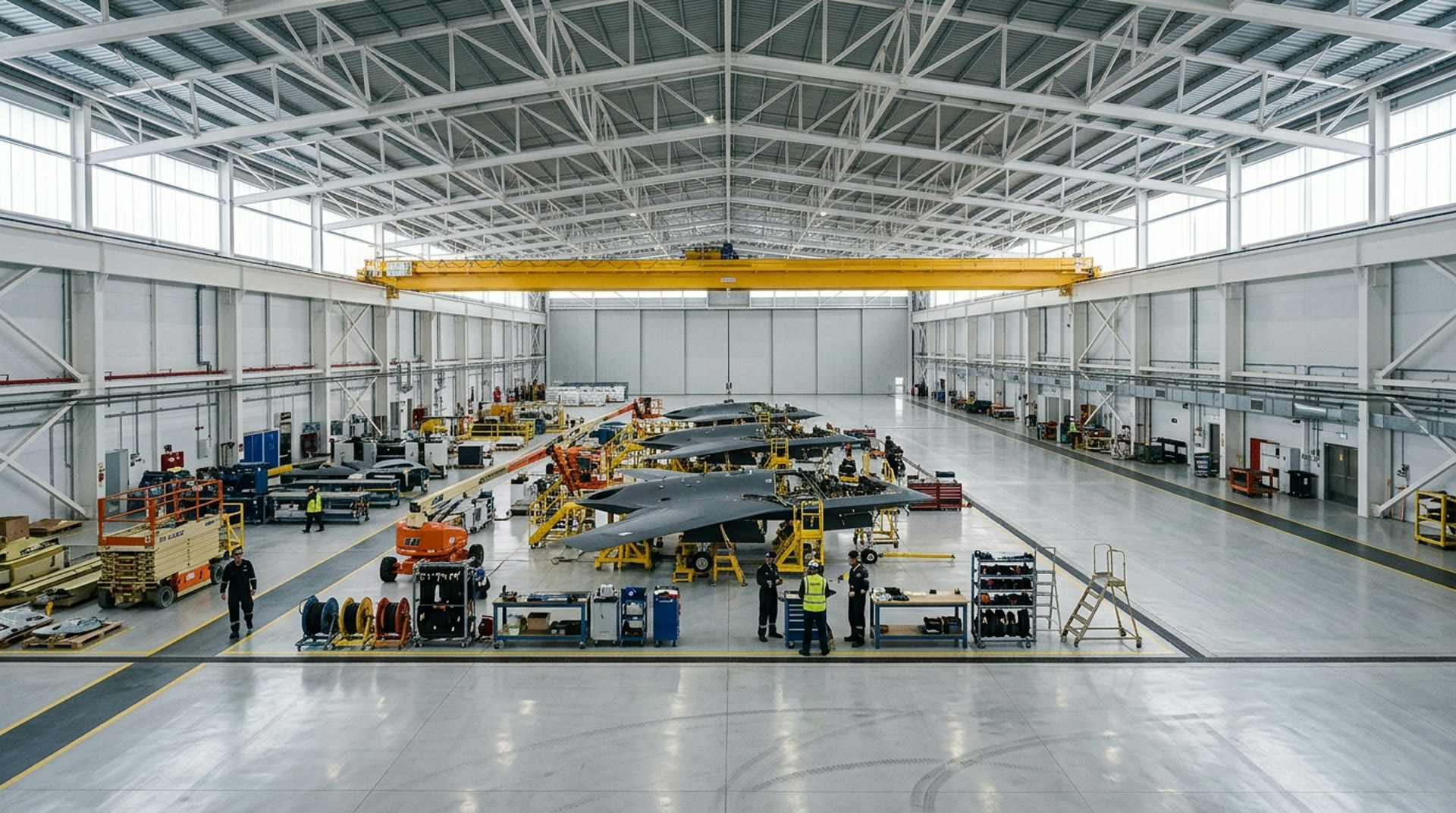
Bay 01 as designed — 300 ft clear span, 55 ft to underside of truss. Utilities on overhead bus drops; no floor trenches, so a line reconfigures in 90 days.
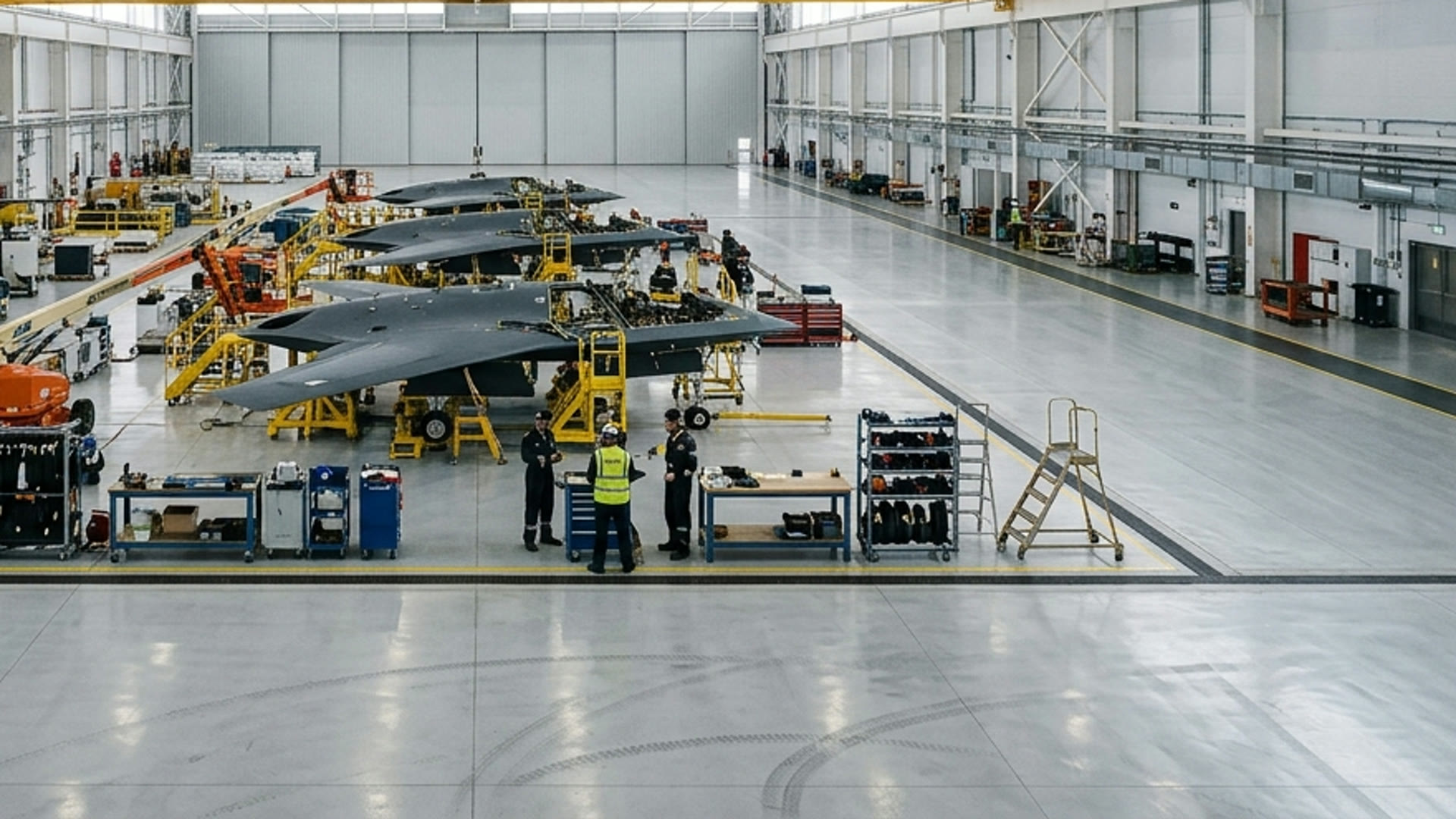
FAL-A1 as designed — twelve stations, 20 h takt, 10-day span time. Two lines at 150 aircraft a year each.
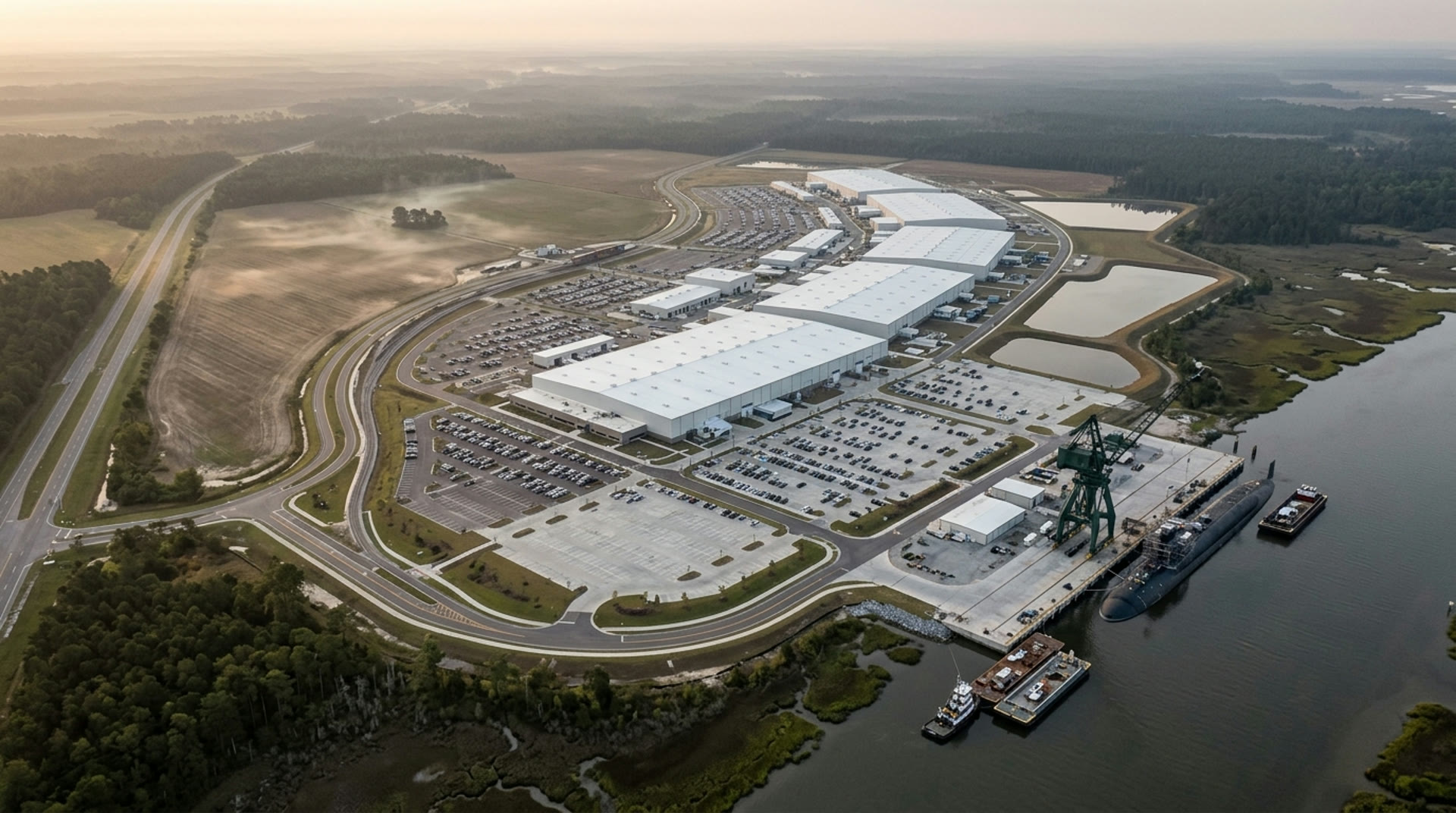
The outfitting quay as designed — 1,850 ft of face at −34 ft MLW. A LEVIATHAN will leave the shiplift and be in blue water the same day.
Capacity
What is planned to come out at full rate
Full rate is 2032: two production shifts on a 5 × 9 pattern, 250 working days, with a weekend crew on composites, additive and test — because autoclaves and powder-bed machines want continuous duty and people do not.
| WRAITH | 300 — two pulse lines plus surge |
|---|---|
| POLTERGEIST | 4,000 — one additive airframe SKU, three configurations |
| BANSHEE | 2,400 |
| SHADE | 12,000 — 6 h span time, the highest-volume line on site |
| LEVIATHAN | 12 — five build positions, 140-day span, one launch every 30 days |
| STYX | 48 — six build positions |
| VEIL | 40,000 |
| LANTERN bus | 96 — ISO 7 cleanroom |
At the $21M unit cost target, FAL-A alone would put $6.3B of aircraft out the east door every year. The campus is costed at $4.6B to build. The payback argument for this site is not subtle, and it does not depend on any of the other nineteen lines.
Scope discipline
What is deliberately not in the plan
- Energetics. No warhead loading, no motor casting, no propellant. Explosive safety quantity-distance arcs are incompatible with 4,200 people on 5.4M ft², and we are not going to pretend otherwise. Effectors ship inert.
- A runway. The aircraft is designed not to need one.
- A deperming facility. Twelve hulls a year does not justify one; Kings Bay is 98 miles away.
- A graving dock. A 600 t shiplift covers the whole product line.
FORGE OS
REVENANT LEDGERFORGE OS is the software that will run the plant, and its organizing object is not the work order. It is the chain of custody of a single physical item, from the mill heat it was poured in to the serial number that comes home from a fight.
Scheduling a plant and reconfiguring a line is table stakes, and FORGE OS is specified to do both. What it adds is the thing that is hard to retrofit: every operation, torque value, cure ramp and test limit written into a hash-chained record as it happens, signed, and carried with the part. The output of a plant running FORGE OS is a product and a proof.
Designed, not yet operating What follows is the specified architecture — no part of it has run in a production plant, because the plant does not exist. The underlying ledger primitive is shared with REVENANT.
-
01 · Genesis
Nothing without a chain enters work in process
Every physical item gets a Material Identity Record the moment it crosses the fence: a plate heat, a prepreg roll and its out-time clock, a powder lot and its reuse count, a purchased assembly, a printed part. The record binds supplier CAGE code, PO line, mill certification, heat and lot number, the receiving scan, and the incoming inspection result. Its hash is the genesis block of that item's chain. There is no manual override. There is a quarantine cage.
-
02 · Signature
Signed at the point of work, by the machine that did the work
Every machine on the site will carry a TPM 2.0 / DICE device identity provisioned at commissioning and never exportable. The CNC signs its own cycle record. The autoclave signs its own cure profile, thermocouple by thermocouple. The torque tool signs the torque, the angle and the joint. Operators sign with a PIV-derived credential at the station. There is no typing it in at the end of shift — if a tool cannot sign, its output is quarantined by default, and that is a designed behaviour, not a failure mode.
-
03 · Binding
Identity has to survive contact with the physical world
Details are direct-part-marked with DataMatrix per MIL-STD-130N. Major assemblies add a passive UHF RFID tag. The parts that actually matter — the REVENANT compute module, the crypto boundary, the flight control board — carry a PUF-derived on-die identity. A counterfeiter can photograph and reprint a DataMatrix in an afternoon. A PUF cannot be copied, because it is manufacturing variation rather than data. The part proves itself electrically or it does not fly.
-
04 · Anchor
Append-only, hash-chained, and witnessed by three parties
This is the plant instance of REVENANT LEDGER — deliberately the same primitive the fielded systems use, so a factory record and a combat record verify with the same tool. Every event references the previous hash. Batch roots are cut on a fixed interval and cross-signed by three independent witnesses: the FORGE-1 HSM cluster, the corporate HSM in another state, and a government-held witness node we offer to DCMA and DCSA.
This is not a blockchain and we will not call it one. No consensus protocol, no token, no distributed ledger — a transparency log with independent witnesses, which is the boring, well-understood, actually-deployed version of the idea.
-
05 · Proof
You get a proof, not a report
Ask FORGE OS for the as-built of WRAITH serial 041 and in under two seconds you get every heat, every prepreg roll and its out-time, every powder lot, every cure profile, every torque value, every NDT indication, every deviation, every waiver, and every human who signed anything — together with a Merkle inclusion path. The customer does not have to trust our database. They run a public verifier against our public key and confirm that the record they were shown is the record that was written, in the order it was written, and that nothing since has been altered or removed. An auditor with a laptop can falsify our claim without our cooperation.
-
06 · Closure
From a fielded anomaly back to a heat number
Configuration is ledgered too: every change to a CNC program, a cure recipe, an inspection plan or a test limit is a signed, two-person-integrity event carrying a diff. The saboteur who moves a torque spec by 8% leaves a signed, witnessed, timestamped record of having done it. And when a fielded system's own REVENANT LEDGER reports an anomaly, the serial resolves straight back into the plant chain, so the affected population is computed by lot instead of guessed by fleet. A suspect actuator lot goes from "ground 300 aircraft" to "inspect the 14 that took parts from heat X." That capability, exercised once, pays for the system.
Honest limits
What the ledger cannot do
The ledger proves that a record was written and has not been altered since. It does not prove that the record was true at the moment of capture. A calibrated-out sensor, a colluding operator pair, or a compromised machine writing signed lies produces a perfectly verifiable false record. Anyone selling a provenance system that claims otherwise is selling a story.
What we do about it:
- Two-person integrity on high-consequence steps, enforced by the credential rather than by policy.
- Machine-signed data with no human in the write path wherever it is physically possible.
- Random independent re-measurement of 2% of ledgered attributes, by a metrology team that reports outside manufacturing, with the re-measurement itself ledgered. A false record and a true re-measurement diverge, and the divergence is permanent.
- DCMA will get read access to the same proofs we use internally — not a report we generate for them, the same log.
Plant-floor control is specified as an air-gapped OT network, Purdue levels 0–3, with a one-way data diode to the enterprise. Ledger writes travel outward only. Nothing on the internet will be able to reach a machine on this site.
FORGE OS is costed at $180M of capital, about 110 people, and roughly 3% of touch labor. One counterfeit FPGA inside a flight control stack costs a fleet. We did not spend long on that trade.
Ramp schedule
Build it with usGroundbreaking to first article is twenty months of construction plus six months of tooling and process qualification. The critical path is not the building. It is autoclave delivery and qualification, which is why a 24-month lead item is ordered a quarter before anyone turns dirt.
| Date | Milestone | Gate |
|---|---|---|
| 2026 Q3 | Site control — purchase option on 1,100 acres. Phase I environmental assessment, a 180-boring geotechnical campaign, wetland delineation opens. | — |
| 2026 Q4 | Georgia incentive package closed. Autoclave and AFP capital ordered — 24-month lead, before the building exists. USACE Section 404/10 pre-application. Title V air permit filed. | G1 |
| 2027 Q1 | Groundbreaking. Mass grading begins — 4.1M CY, balanced on site. Rail spur agreement executed. Welder school opens, two years before the first keel. | G2 |
| 2027 Q2 | Bay 04 composites steel erection. Bay 05 foundations. Hunter AAF Enhanced Use Lease executed. | — |
| 2027 Q3 | Berth pocket dredging starts — season-constrained. Temporary construction dock in service; autoclave #1 delivered by barge, because it will not go on a road. | G3 |
| 2027 Q4 | Bay 01 slab placed. Bay 05 enclosed. FORGE OS core deployed to Bays 04 and 05 — a year ahead of first article. Tooling installation begins. | — |
| 2028 Q1 | Bays 04 and 05 beneficial occupancy. First production detail parts. Composite process qualification campaign: coupons, then elements, then components. | G4 |
| 2028 Q2 | FAL-A1 tooling installed and dimensionally qualified. First WRAITH major structural assemblies in the jig. Bay 01 beneficial occupancy. | G5 |
| 2028 Q3 | First article — WRAITH FA-001 rolls out of FAL-A1. | G6 |
| 2028 Q4 | FA-001 moves to Hunter AAF for functional check flight. Bays 02 and 07 occupancy. Second dredge season complete. | — |
| Year | WRAITH | LEVIATHAN | STYX | People |
|---|---|---|---|---|
| 2028 | 1 (FA) | — | — | 1,150 |
| 2029 | 40 | keel #1 | 2 | 1,900 |
| 2030 | 120 | 1 float-off | 12 | 2,600 |
| 2031 | 220 | 6 | 30 | 3,400 |
| 2032 | 300 | 12 | 48 | 4,200 |
The other risks
Stated with a number attached
A risk without a number is an opinion.
| Labor | Third hyperscale employer into a shed of ~200,000. If wage inflation runs 6%/yr instead of 3%, the burdened hourly base is $30–40M/yr higher by 2032. $40M committed to a workforce housing partnership. |
|---|---|
| Welders | ASME Section IX and NAVSEA-qualified pressure-hull welders do not exist in this shed in the numbers we need. Nobody's shed does. $18M welder school opens 2027 Q1; $9M/yr travel-welder premium budgeted 2029–2031. |
| Permitting | The Georgia coast is the only known calving ground for the North Atlantic right whale, with separate sea turtle and sturgeon windows. Hopper dredging is effectively April–November, which makes the berth pocket a two-season job. |
| Dredging | 1.42M CY of new work. Federal placement capacity is finite — we need 4.1M CY of fill and the harbour needs somewhere to put material, so beneficial-use placement on our own site is in the permit application. $34M contingency held against unsuitable material. |
| Demand | 300/yr requires a program of record at that quantity. Split two ways, our realistic rate is 100–150 and FAL-A runs at 45% for three years. We sized the buildings for 300 and the tooling for 150, with tooling capital gated on award. |
| Concentration | One campus is one target, one hurricane, and one labor market. We are accepting that for five years in exchange for a single quality system, and saying so out loud. FORGE-2 siting study opens 2029. |
Suppliers
programs@fantom.aeroAbout 1,100 direct suppliers at full rate. Roughly 38% within 500 miles at start of rate, which is lower than we want — the Tier-1 aerospace base is concentrated in the Midwest and the West, and we are not going to pretend the Southeast base exists at the depth we need. We are going to grow it: a $120M supplier development fund, dual sourcing on every critical-path item, and a standing requirement that any single-source critical-path item carries either a qualified second source or 180 days of bank stock within 24 months of award.
The make/buy rule. We make a thing if it is on the critical path with fewer than three qualified sources, or if it is the thing an adversary would most want to touch. That means we make composite primary structure, additive airframes, pressure hull fabrication and welding, final integration, the REVENANT compute module, and the crypto boundary hardware. We buy the turbofan, actuators, seekers, batteries, connectors, standard hardware and raw stock.
| Distribution | No independent-distributor purchases, at all, inside the ledger boundary. OCM or authorized only. At end-of-life we requalify rather than buy broker stock — 9–14 weeks and about $4M/yr of obsolescence engineering, and the cheapest insurance on the site. |
|---|---|
| Counterfeit | AS5553 avoidance system, AS6081 flow-down, AS6171 test methods, DFARS 252.246-7007 and -7008 |
| Inspection | XRF, 2D and CT X-ray, acoustic microscopy, decapsulation, curve trace, full destructive physical analysis — 100% on anything flight-critical or inside the ledger boundary |
| Covered nations | Section 889 screening at every renewal; 10 U.S.C. §4872 materials; and covered printed circuit boards, which bite in 2027 — inside our qualification window, not after it |
| Quality | AS9100D, with AS9145 APQP and PPAP flowed to every structural and flight-critical supplier |
| Software | CycloneDX SBOM to the NTIA minimum elements, reproducible builds, SLSA build level 3, signed on the same root of trust that issues our machine identities |
Careers · FORGE-1
Four thousand two hundred people by 2032
2,180 operators, assemblers, welders and technicians. 380 manufacturing and industrial engineers. 300 in quality, NDT and metrology. 160 building FORGE OS. We are targeting 920 of the 4,200 out of the Fort Stewart and Hunter Army Airfield pipeline, because they arrive with the trades, the discipline, and the clearance.
Hiring opens against the 2027 Q1 groundbreaking. The welder school opens the same quarter — two years before the first keel — and we will pay you to attend it.
| Production | 2,180 |
|---|---|
| Manufacturing engineering | 380 |
| Supply chain | 340 |
| Quality & metrology | 300 |
| Maintenance & marine ops | 290 |
| Test & evaluation | 210 |
| Program & support | 210 |
| FORGE OS, IT, OT security | 160 |
| Security | 130 |
| Total | 4,200 |
FORGE-1 figures are program planning values as of 2026 Q3 and are subject to design development, permitting and award. Site acreage, area under roof, employment, first-article date and WRAITH rate are program commitments. Everything else will move.