
Sea · Undersea and surface systems
The one domain where
the network is guaranteed to fail
Seawater attenuates RF at roughly 1,400 dB per kilometre. There is no cloud under water. Every vehicle down there is, for most of its life, alone — so we built four systems that are designed to be alone.
The sea domain thesis
Revenant — the autonomy OS01 · Alone by default
Useful undersea communication is acoustic. That means 2.4 kbps at 8 km on a good day, 200 bps at 30 km on a normal one, a five-second one-way latency, and a channel that changes with the tide. There is no mesh to lean on and no cloud to fall back to.
This is why REVENANT CORE is a sea product before it is an air product. An autonomy runtime that degrades toward a cloud is useless at 400 m. A runtime that degrades toward itself is the only thing that works down there. Every system on this page carries the entire mission model, the ROE engine and the world model on board, and none of them need permission to keep working.
02 · Legally crowded
An aircraft over a battlefield is a military object in a military place. A 190-tonne autonomous submersible transits the exclusive economic zones of countries that have agreed to nothing, an unmanned surface vessel shares a traffic separation scheme with merchant traffic, and an autonomous undersea effector sits on a seabed under a shipping lane for six months.
The engineering is solvable. What has actually kept these systems out of the water is that nobody could answer a lawyer. REVENANT LEDGER is the answer: every observation, classification, human authorization and engagement decision is hash-chained and signed at the edge, and it is exportable, replayable and admissible. In this domain that is not a feature. It is load-bearing structure.
03 · Port-independent
A shipyard is a coordinate. There are eleven yards in the United States that can handle an extra-large uncrewed undersea vehicle and an adversary's targeteer can list all eleven on one page.
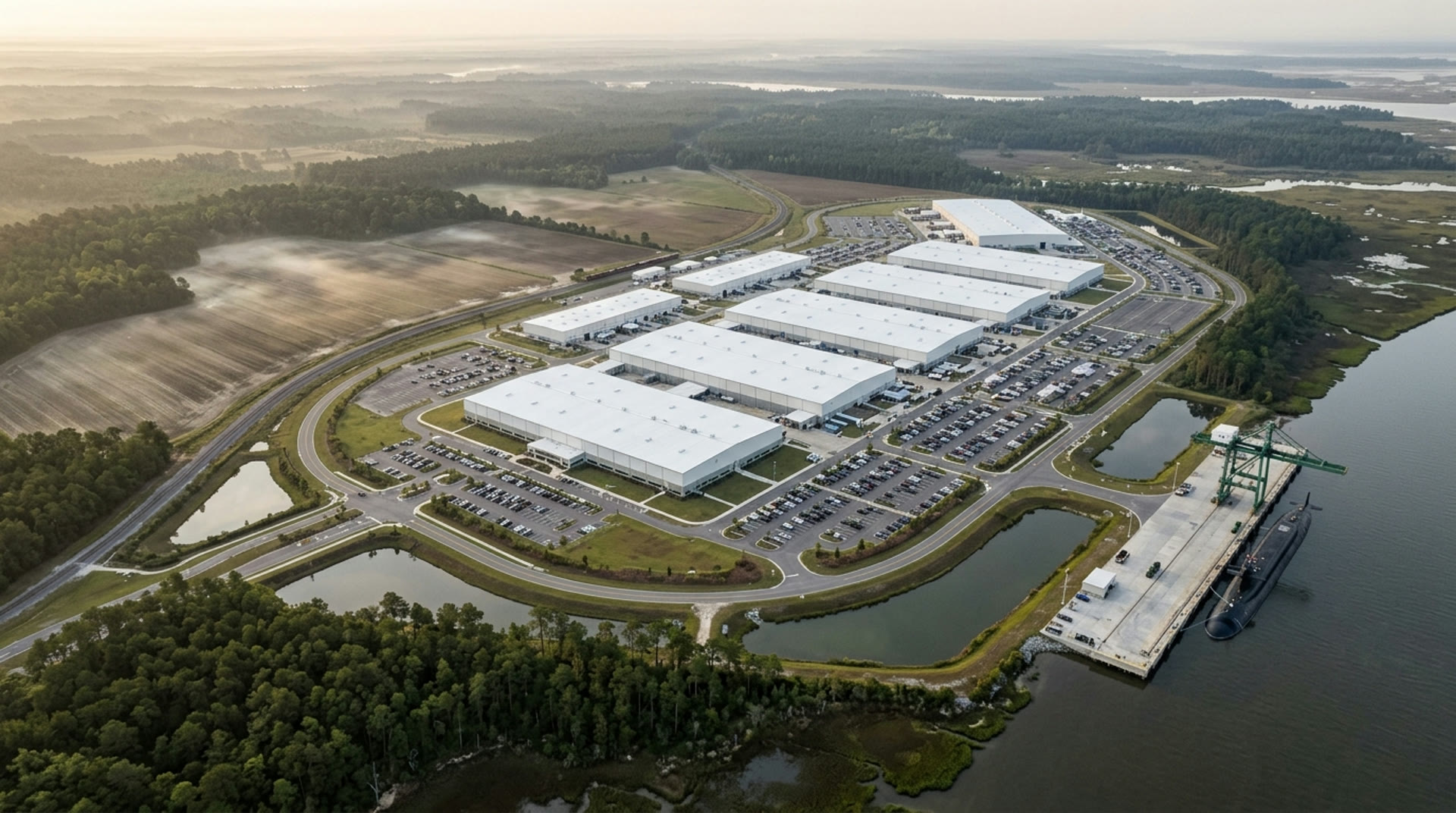
LEVIATHAN goes into the water at any commercial pier with six metres of depth, forty metres of quay wall, eleven people, and one crane rated 30 t — because no single lift in its entire assembly sequence exceeds 29.4 t. STYX sorties from any pier or well deck under its own power. In a Pacific fight, the hull that can be assembled inside the theatre after the shooting starts is worth more than the better hull that has to be sailed in from Newport.
The sea arsenal
FORGE-1 — where they are builtFour numbers that define the domain
Why these four, and not four others
Government & Primes
Request a sea domain briefing
Classified and unclassified briefings on LEVIATHAN, STYX, DEADFALL and TIDEWALL are available to US government customers, allied ministries of defence, and commercial submarine-cable operators.
Request a briefing programs@fantom.aero
Every figure on the sea domain pages is a design target derived from first-principles analysis, not a trial result. Where a number is an estimate, we say so on the product page. No export-controlled information is published on this site.