
Sea · XLUUV-1 · Extra-Large Uncrewed Undersea Vehicle
Leviathan
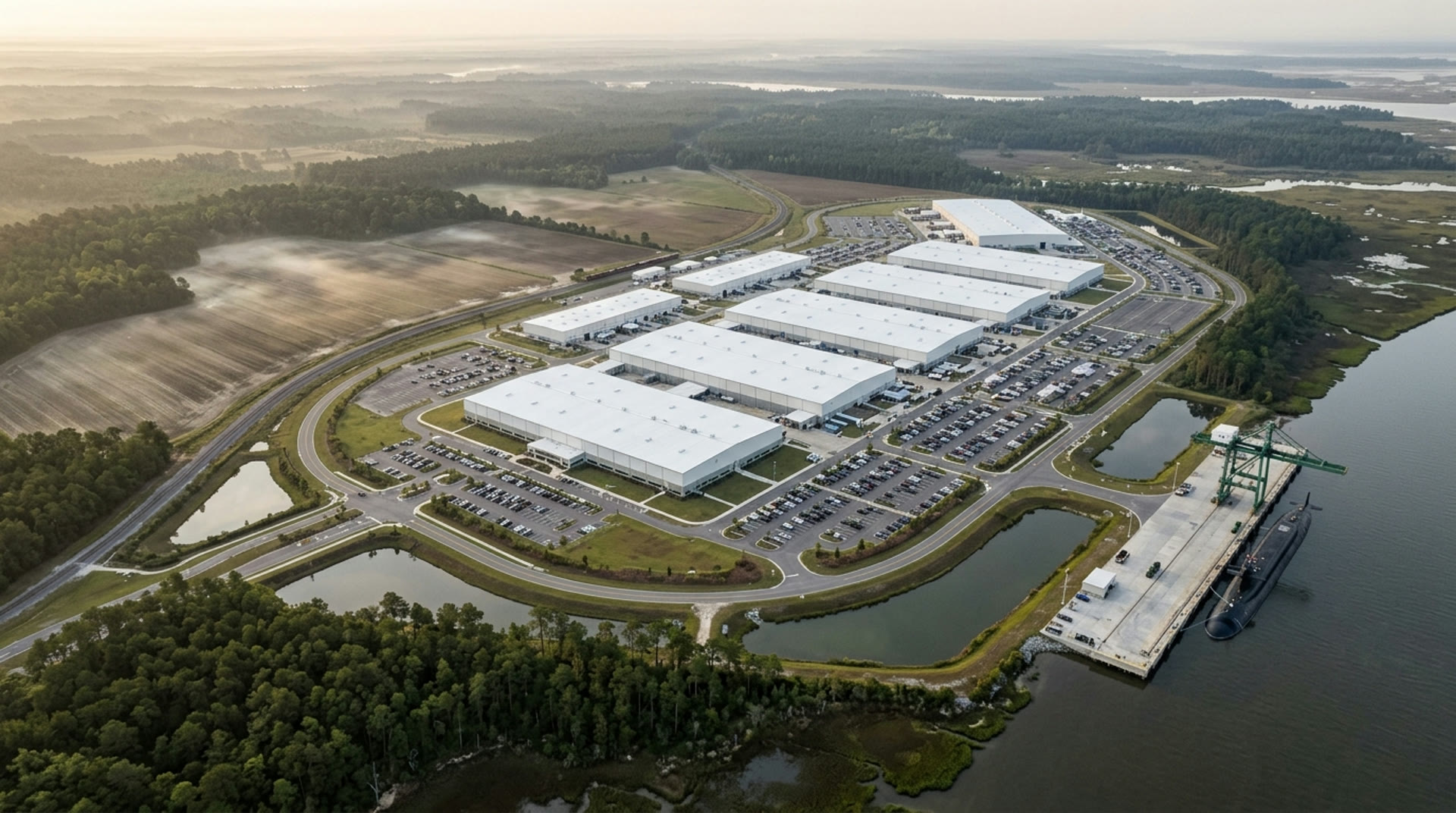
A 190-tonne autonomous submarine that goes into the water at a fishing pier.
Mission
Revenant CoreDeliver a 21-tonne payload 6,500 nautical miles from a commercial pier to a designated seabed or water-column position, hold it there for weeks without surfacing, and act on it — lay, sense, strike or recover — with no communications, no GPS and no support ship.
LEVIATHAN is pier-launched. The heaviest single lift in the entire sequence is 29.4 t, across three independently floating modules — so no drydock, no crane over 30 t and no shipyard queue stands between a customer and a boat in the water. The whole design is bent around a single requirement that is not a performance requirement at all: it must go into the water at any commercial pier with six metres of depth, forty metres of quay wall, one crane rated 30 t at working radius, and eleven people.
Every other choice on this page falls out of that one line — the free-flood energy casing, the three-module pressure architecture, the ambient-pressure payload bay, and the decision to accept a 400 m hull instead of a 1,000 m one.
Parameters
| Class | Extra-large uncrewed undersea vehicle |
|---|---|
| Length overall | 68.0 ft / 20.73 m — three modules: 12.4 + 42.0 + 13.6 ft |
| Envelope beam | 12.8 ft / 3.90 m over the free-flood casing |
| Pressure hull | 8.53 ft / 2.60 m ID, ring-stiffened HSLA-100, 22 mm shell, frames at 610 mm |
| Light ship | 88.4 t |
| Surfaced displacement | 131 t loaded, main ballast blown |
| Submerged displacement | 190 t |
| Reserve buoyancy | 11.0 % (14.3 t). The free-flood casing is wet at all times and is not reserve buoyancy. |
| Operating depth | 400 m, continuous, unrestricted |
| Test depth | 600 m — proof-tested on every hull |
| Calculated collapse | 1,010 m inter-frame / 1,180 m general instability. SF 1.68 on test depth. |
| Payload bay | 42.0 ft · 12.80 × 2.20 × 1.90 m clear · 26.4 m³ · ambient pressure · 21,000 kg |
| Payload trim tolerance | ±900 kg, absorbed by variable ballast without re-leading |
| Max speed | 12.0 kt on the battery; 14.0 kt combined burst, 30 min |
| Transit speed | 8.0 kt hybrid / 5.0 kt economical |
| Silent loiter | 3.0 kt on the battery, no snorkel |
| Range | 6,500 nm at 8 kt (34 days) or 10,800 nm at 5 kt (90 days) |
| Silent endurance | 15.2 days / 1,096 nm submerged at 3 kt |
| Bottomed watch | 117 days on the pack, hotel load only |
| Mission duration | 90 days — set by fouling and the maintenance-free interval, not by energy |
| Propulsion | 260 kW rim-driven ducted permanent-magnet propulsor, 7 blades, highly skewed. No gearbox, no shaft, no shaft seal. |
| Energy | 1,315 kWh pressure-tolerant LFP (1,184 kWh usable) + 65 kWe genset + 9.4 t F-76 compensated |
| Sonar | AN/WQQ-9(V): 2.4 m conformal bow array, port and starboard flank arrays, 900 m thin-line towed array, 90 kHz obstacle avoidance, multibeam mapper |
| Navigation | Strategic-grade RLG INS (0.0015 °/h), 300 kHz DVL, chip-scale atomic clock, sound-velocity profiler, triple-voted depth |
| Autonomy | REVENANT CORE, dual redundant, 40 W envelope each |
| Comms | REVENANT MESH acoustic 2.4 kbps at 8 km; blue-green optical 12 Mbps at 90 m; on mast — Iridium Certus, UHF SATCOM, HF, Link 16 via REVENANT LINK |
| Crew | 0 |
| Unit cost target | $41M at 12/yr from FORGE-1 |
| Bottomed | 0.42 kW |
|---|---|
| 3.0 kt | 3.24 kW — silent hotel |
| 5.0 kt | 12.5 kW |
| 8.0 kt | 43.1 kW |
| 10.0 kt | 85.0 kW |
| 12.0 kt | 150.6 kW |
| 14.0 kt | 249.6 kW — burst |
The energy section, and where the range actually comes from
01 · Drag
LEVIATHAN is a body of revolution inside a free-flood casing. Wetted area including the casing, control surfaces and propulsor duct is 215 m². Drag coefficient on wetted area, from 1:8.5 towing-tank data corrected to full-scale Reynolds number, is 0.0038 at low speed, rising to 0.0042 above 12 kt as the casing steps begin to separate.
The cubic term is the whole story. Going from 5 kt to 8 kt costs 3.4 times the power for 1.6 times the speed. LEVIATHAN is a five-knot vehicle that can do eight when the schedule demands it and twelve when something has gone wrong.
02 · Installed energy
Ninety-six pressure-tolerant LFP cassettes — 13.7 kWh and 86 kg each — clip into free-flood saddles along both flanks of the payload module. 1,315 kWh installed, 1,184 kWh usable at 159 Wh/kg pack level, 8.26 t total.
LFP rather than NMC, deliberately. A cell in an oil-compensated housing inside a flooded casing cannot be fought if it goes into runaway. LFP's runaway onset is roughly 60 °C higher and its gas output is not a fuel-air problem. We give up about 28% of gravimetric energy density for that and we would make the trade again.
Fuel is 9.4 t of F-76 in seawater-compensated bladders in the ventral casing, 11.1 m³. Because the bladders are compensated, burning nine tonnes of fuel over a 34-day transit produces no trim change and no free-surface effect.
03 · Range, derived
At 8 kt the bus draws 43.1 kW. 6,500 nm is 812.5 h, so 35,020 kWh. One full battery discharge covers 1,184 kWh of it; the remaining 33,836 kWh comes from fuel at 33% end-to-end efficiency — 102,533 kWh thermal, 369 GJ, 8.64 t of F-76. The bunker is 9.4 t, an 8.8% reserve.
At 5 kt the boat has fuel for 20,000 nm. It does not have hull coating, filters or bearings for 20,000 nm. Planning range at 5 kt is capped at 10,800 nm and 90 days by the maintenance-free interval, and that is the number to plan against.
04 · Snorkel duty
The generator delivers 63 kW to the bus after auxiliaries, which fixes the snorkel duty cycle exactly. At 5 kt it is 19.8% — about 40 hours of mast exposure per thousand miles. At 8 kt it is 68.4%, and the induction mast is out of the water for two thirds of the transit.
That is the honest cost of an eight-knot transit and no mast design fixes it. What helps is real but partial: a retractable induction mast with a dielectric radar-absorbent fairing and a head area under 0.05 m², zero RF emission while snorkelling, and a planner that schedules charging on the far side of a threat's sensor horizon and preferentially in sea state 3 or above, where a mast wake is lost in clutter.
The doctrinal answer is better than the engineering one. LEVIATHAN does not snorkel inside the operating area. It arrives with a full pack and fights the tactical phase on the battery.
05 · The recharge
Refilling 1,184 kWh while snorkelling at 5 kt puts 50.5 kW into the pack. A full recharge is a 23.4-hour continuous snorkel, and it is the most dangerous thing this vehicle does.
Each cycle costs 303 kg of fuel, so the bunker contains 31 silent-cycle recharges. That is the real currency of a LEVIATHAN mission — not nautical miles, not days. Thirty-one chances to go quiet again.
Pier launch: no drydock, no lift over 30 tonnes
The critical insight is that the structural joint and the pressure boundary are different surfaces. Each of the three modules contains its own complete, continuous pressure vessel with its own domes. Modules bolt to each other outside those vessels, in the free-flood casing, and pass power and data through 3,000 m wet-mateable connectors.
The consequence is the whole argument: a bad module joint floods a free-flood volume that is already full of seawater. It is a nuisance, not a loss. There is no scenario in which a joint made at a pier, by a team that could not dry-inspect the mating faces, sinks the vehicle.
| Bow · 12.4 ft | 22.8 t — conformal bow array, navigation suite, autonomy bay, forward trim and main ballast |
|---|---|
| Payload · 42.0 ft | 29.4 t — ambient-pressure payload bay, energy saddles, fuel bladder bays, variable ballast |
| Stern · 13.6 ft | 26.3 t — generator room, snorkel and comms masts, rim-drive propulsor, X-plane surfaces, aft ballast |
| Dry structure | 78.5 t across three lifts |
| Everything else | Installs by hand, pallet jack or a 2 t pier forklift — 86 kg battery cassettes, fuel by hose, payload modules at ≤5.4 t, lead trim in 25 kg ingots |
Finding a 30-metre target after 42 days without GPS
This is the hardest unglamorous problem in the vehicle. A strategic-grade strapdown INS at 0.0015 °/h gyro bias drifts 0.22 nm per hour free-inertial — after four hours you have lost a kilometre. Inertial alone is not a navigation solution. It is a smoothing filter between fixes.
| DVL, bottom lock | 0.05 % of distance travelled. Shelf and slope only, to 200 m altitude. |
|---|---|
| DVL, water track | 0.6 % DT — you are navigating against a moving water column. This is the honest hard case. |
| Terrain-relative nav | Bounds to 40 m (1σ), re-fix every 6 h. Needs ≥40 m of relief per 2 km cell; gives nothing on an abyssal plain. |
| Gravity / magnetic anomaly | Bounds to ~1.2 nm. Weak, but it works exactly where terrain-relative navigation is blind. |
| Acoustic one-way-travel-time | Bounds to 45 m (1σ) against two surveyed TIDEWALL or DEADFALL nodes inside 20 km |
| Expendable buoy | 8 m, one detectable event, $1.9k. Ten carried. |
| Delivered, 42-day patrol | Under 60 m (1σ) on a 42-day-old waypoint, against a 200 m requirement — on a terrain-capable route |
The limit on acoustic ranging is not the clock. A chip-scale atomic clock in holdover accumulates about ±1.4 ms over 30 days, which is 2.1 m of range error at 1,500 m/s — irrelevant. The error driver is sound speed. A 0.3% error in the assumed profile over a 20 km path is 60 m, thirty times the clock contribution. LEVIATHAN carries a sound-velocity profiler and re-measures on every depth excursion, cutting ray-trace error to about 0.06% and the 20 km range error to 12 m. That is why the vehicle deliberately porpoises through the thermocline once per watch even when the mission does not ask it to.
And the network is also the navigation grid. Any surveyed Fantom node — a TIDEWALL sensor, a laid DEADFALL — is a travel-time beacon. A LEVIATHAN operating inside its own laid field navigates better than one in open water. The sensor field and the navigation infrastructure are the same objects.
CONOPS
Phase 01 · Assemble and launch
Five days, eleven people, one 30-tonne crane
Three modules arrive on self-propelled transporters. Each is lifted into the water on a flotation collar — every module floats independently. They are drawn together at a mooring dolphin by capstan on a rail-guided carriage; a diver-tended ring gauge verifies concentricity to 0.8 mm before the 48-bolt clamp is tensioned to 340 N·m. Each joint's O-ring interspace is then pressurised to 1.5× rated differential and held 30 minutes, so a bad seal is found on the pier and not at 400 m. Energy, fuel, payload and trim lead go in last, and the boat weighs itself by diving to 3 m alongside.
Phase 02 · Transit
Eight to thirty-four days
5 kt economical, or 8 kt when the schedule binds. Snorkel windows are planned against known overhead revisit times. Navigation on DVL and terrain-relative fixes. LEDGER running from the genesis block signed at the pier.
Phase 03 · Approach
Last recharge outside the wire
Twelve to thirty-six hours before the operating-area boundary, the boat takes its final 23-hour charge. From the boundary inward, the generator does not start.
Phase 04 · Execute
Fifteen days silent, or 117 days bottomed
Lay, sense, strike or deliver, according to the payload fit. Every classification and every engagement decision is hash-chained and signed at the edge with no uplink of any kind. The vehicle does not need permission and does not ask for it.
Phase 05 · Report
Opportunistic, never scheduled
Acoustic to a TIDEWALL gateway, optical to a STYX on the surface, or a single burst from a mast at a time and place of the vehicle's own choosing. A vehicle that reports on a schedule is a vehicle you can wait for.
Phase 06 · Egress and recharge
Leave the area to breathe
23.4 hours to refill the pack, at 303 kg of fuel per cycle, outside the threat envelope. Thirty-one cycles in the bunker.
Phase 07 · Recover or cache
Three days at any pier — or don't come back at all
Demate reverses the launch sequence. Alternatively the vehicle bottoms itself in a cache position and waits 117 days on hotel load until it is needed again, which removes the return leg from the campaign plan entirely.
Why it is built this way
A shipyard is a coordinate. There are eleven yards in the United States that can handle a vehicle of this size and an adversary's targeting cell can list all eleven on one page. A boat that must be built, launched and recovered at one of them is a boat whose availability an enemy gets a vote on.
So we inverted the constraint. Instead of designing the best 190-tonne submersible and then asking what it takes to launch it, we fixed the launch envelope first — 30 tonnes, six metres of water, eleven people — and designed backwards from there. That produced the three-module architecture, the decision to put the energy outside the pressure hull in the free-flood casing where it can be installed one 86 kg cassette at a time, and an ambient-pressure payload bay that a customer can integrate into without touching the pressure boundary or our safety case.
What is hard, stated plainly
| Recovery, not launch | Putting a live 190 t vehicle in the water at a pier is straightforward. Getting a damaged, negatively buoyant one off a 400 m seabed and back onto a pier with a 30 t crane is not. Emergency deballast blows the ballast tanks from 400 m in 40 s on a live boat; a dead one below 400 m is a salvage job. We budget one hull lost per 60 deployments and we price it in. |
|---|---|
| Snorkel exposure | 68.4 % duty cycle at 8 kt is the largest single detection risk in the program and it is not fully mitigable. |
| Battery fire in a flooded casing | LFP, individually fused and individually jettisonable cassettes, in the best heat sink on Earth. Residual: a runaway cassette makes noise and gas, both detectable. Accepted. |
| Biofouling | 8 µm of soft fouling costs about 9 % of drag, straight off the range. Foul-release silicone plus an in-mission re-fit of the drag model from measured thrust and speed, so the energy planner never reports a range the boat cannot make. It will still lose miles. |
| Wet-mate connectors | 600-cycle-rated connectors carrying 800 VDC through a joint made by a diver. The pressure architecture makes a joint failure benign; a connector failure is a mission kill. Redundant paths both sides of every joint, and we expect to learn things in the first ten hulls. |
| Certification | There is no IMO regime for a 190 t unmanned submersible and the Navy's UUV safety certification process is immature. The certification schedule is a larger risk to first deployment than any technical item on this page, and anyone who tells you otherwise has not done it before. |
Related systems
All sea systemsGovernment & Primes
Request a LEVIATHAN briefing
Hull, energy-section and payload-integration data packages are available to US government customers and allied ministries of defence under an executed agreement.
Request a briefing programs@fantom.aero
Every figure on this page is a design target derived from first-principles analysis, not a trial result. No hull has been laid and no test article exists. LEVIATHAN is a design, a weight statement and a build plan; FORGE-1, where it would be built, is a site under option with a 2027 groundbreaking. No export-controlled information is published on this site.