
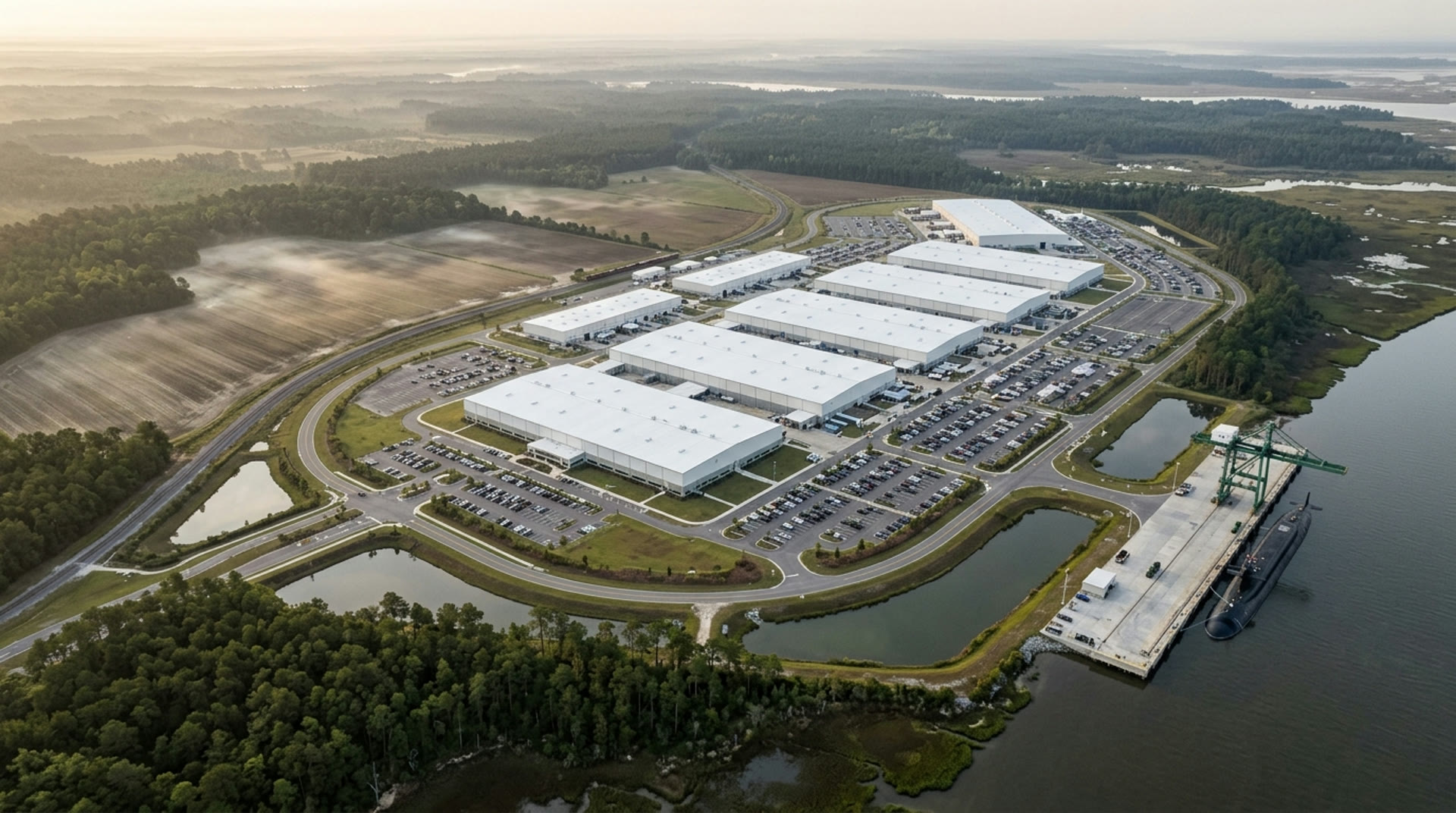
Space · FSV-1 · Space domain awareness constellation
Lantern
Custody, not detection. Forty-eight satellites, optical and RF, holding a continuous track file on every object that matters — instead of finding it again every pass and hoping it is the same one.
Mission
The difference between finding a thing and keeping it
Detection answers is something there. Custody answers is this the same object doing the same job. Only one of those is intelligence.
A ground radar fence or a surveillance telescope detects an object as it crosses the sensor's field of view, produces an observation, and hands it to a catalogue. The next observation may come an orbit later, a day later, or never — because if the object manoeuvred in the gap, it is no longer where the propagator said it would be, and the observation becomes an uncorrelated track. Somebody then has to work out, by hand and after the fact, which of several thousand objects it used to be.
LANTERN never lets the covariance grow that far. The track file is never broken, so it never has to be re-correlated, so the object's history survives. That history is the whole product. Nobody can say a satellite is behaving abnormally without an unbroken record of it behaving normally, and every ground catalogue on Earth loses that record the first time a target manoeuvres between passes.
The constellation is three shells: twenty-four satellites in a sun-synchronous low Earth orbit watching LEO, eight in the GNSS shell at 20,200 km watching the orbits nobody watches, and sixteen sitting in the geostationary belt staring at it. Each carries a 450 mm telescope, a 120 mm wide-field acquisition camera, a 0.5–18 GHz RF payload, and enough compute to do the astrometry on board — because the alternative is downlinking 2.9 terabits an hour of pixels, and that does not close at any price.
Key figures
The orbital mechanics
Custody is a geometry problem, not a sensor problem
s = 3 · Δv · t
If an object performs an unobserved impulsive manoeuvre, its along-track position error grows secularly, not randomly. A prograde Δv raises the semi-major axis by 2Δv/n, which slows the mean motion by 3Δv/a, which accumulates as an along-track displacement of 3Δv·t. The result is independent of orbit size, which is why the same equation governs a low-Earth-orbit crosser and a geostationary satellite.
This is the most important equation in the domain, and it says that revisit interval — not aperture — sets custody.
| 1 cm/s | 27 m at 15 min · 648 m at 6 h · 2.6 km at 24 h · 18.1 km at 7 days |
|---|---|
| 10 cm/s | 270 m at 15 min · 6.5 km at 6 h · 25.9 km at 24 h · 181 km at 7 days |
| 1 m/s | 2.7 km at 15 min · 65 km at 6 h · 259 km at 24 h · 1,814 km at 7 days |
| 10 m/s | 27 km at 15 min · 648 km at 6 h · 2,592 km at 24 h · 18,144 km at 7 days |
| Frame at GEO range | 2.08° at 20,000 km = a 733 km box, 366 km half-width |
|---|---|
| LANTERN — 15 min revisit | 135 m/s in a single impulse. GEO station-keeping is about 50 m/s per year. That burn cannot be hidden and cannot be afforded. |
| A good ground catalogue — 24 h revisit | 1.41 m/s. Every geostationary operator on Earth performs burns larger than that routinely. |
| Consequence | The first is custody. The second is a catalogue that re-acquires and hopes. |
Specification
LANTERN parameters
| LANTERN-A | 24 satellites · 1,100 km circular · i = 99.94°, sun-synchronous · 6 planes × 4, RAAN spaced 30° · watches LEO 200–2,000 km |
|---|---|
| LANTERN-M | 8 satellites · 20,200 km circular · i = 55° · 4 planes × 2 · watches the GNSS shells; provides 40,000 km RF baselines |
| LANTERN-G | 16 satellites · 42,164 ± 180 km · 8 drifting west, 8 drifting east at 2.31°/day · ±35° of belt arc each |
| Why sun-synchronous | At i = 99.94° the J2 nodal regression is exactly +0.9856°/day. Every plane precesses at the same rate, so the constellation's internal geometry never drifts and holds its 30° spacing for life with zero station-keeping. |
| Belt coverage | 16 × 70° = 1,120° against a 360° belt. Every geostationary object is inside at least two fields of regard at all times. |
| LEO revisit | 6 min median, 22 min at the 95th percentile, objects 300–1,500 km |
| GEO revisit | 15 min on a custody target; 112 targets per satellite at a 3 s slew and 5 s dwell |
| North-south station-keeping | None on LANTERN-G. Luni-solar drift takes the shell 0.85°/yr out of the belt plane. Worse for range, better for out-of-plane manoeuvres, and it saves 50 m/s a year the optics did not need. |
| Custody telescope | 450 mm clear aperture, f/2.5 three-mirror anastigmat, silicon carbide |
|---|---|
| Detector | 4096 × 4096, 10 µm, back-illuminated CMOS |
| Plate scale / field | 1.83 arcsec/px · 2.08° × 2.08° |
| Limiting magnitude | mV 18.8 at SNR 6 in a rate-tracked 5 s frame · mV 14.5 at 0.25 s for LEO crossers |
| Wide-field acquisition | 120 mm f/2.0, 8.6 arcsec/px, 9.8° × 9.8°, mV 15.6 |
| Absolute astrometry | 0.25 arcsec (1σ) — 24 m cross-range at 20,000 km |
| Stereo range | 61 m from two simultaneous angles-only cuts across an 8,000 km baseline |
| Exclusions | 25° solar keep-out · 10° above the Earth limb |
| Pointing | 0.5 arcsec knowledge · 8 arcsec/s slew · 1.2 s settle to 1 arcsec |
| 3 cm, albedo 0.15, at 1,000 km | mV 14.4 — finer than the ~10 cm LEO catalogue floor |
|---|---|
| 10 cm, albedo 0.10, at 20,000 km | mV 18.5, SNR ≈ 7 |
| 25 cm, albedo 0.10, across the full belt arc | mV 17.0 at 25,000 km, comfortable |
| 1 m², albedo 0.20, at 1,000 km | mV 6.3 |
| For comparison — the same object from the ground at GEO | mV 14.0, in clear weather, at night, from one meridian |
| Measurement floor at GEO | 24 m |
|---|---|
| Along-track, 1 cm/s | 274 m offset in semi-major axis, then unbounded secular drift |
| Radial, 1 cm/s | 274 m along-track / 137 m radial oscillation, once per orbit |
| Cross-track, 1 cm/s | 137 m oscillation, once per orbit |
| Detection threshold | 2 cm/s within one 15-minute revisit. 7 mm/s within an hour. Roughly the impulse of a one-second firing of a small station-keeping thruster. |
| Aperture | 32-element conformal array, body-mounted, four sub-bands |
|---|---|
| Coverage | 0.5 – 18 GHz, 2 GHz instantaneous bandwidth, 12-bit, 4,096 channels on board |
| Sensitivity | −132 dBm/MHz detection threshold at 1 s integration |
| Geolocation | TDOA/FDOA across constellation pairs; 25,000 km baselines at GEO, 40,000 km from antipodal LANTERN-M |
| Time transfer | Two-way optical, 100 ps — 3 cm of range equivalent |
| Emitter geolocation | 1–3 km CEP on a ≥5 MHz emitter at geostationary range |
| Mass / power | 34 kg / 180 W at 30% duty |
| Wet / dry mass | 348 kg / 336 kg (12 kg krypton) |
|---|---|
| Stowed envelope | 1.15 × 0.95 × 2.30 m |
| Power | 1.40 kW EOL array, 40 Ah Li-ion; 488 W orbit-average load, 720 W peak |
| Propulsion | 1 × 600 W krypton Hall, 39 mN, Isp 1,500 s |
| Δv budget | 400 m/s — 223 m/s controlled disposal, 120 m/s station-keeping and collision avoidance, 57 m/s margin |
| Attitude | 3 star trackers, 4 × 0.15 Nms wheels, fibre-optic gyro, 3 magnetorquers |
| Crosslink | 2 × optical terminal, 10 Gbit/s at 5,000 km — also a REVENANT MESH bearer |
| Downlink | Ka 1.2 Gbit/s at 15% duty, S-band TT&C |
| Autonomy | REVENANT CORE — streak detection, astrometry, correlation and manoeuvre hypothesis testing on board |
| Design life | 7 years, consumables for 9 |
| Block differences | LANTERN-G 372 kg with added shielding and a larger array for eclipse. LANTERN-M 411 kg with 6 mm tantalum-loaded shielding for a 7-year MEO dose under 40 krad(Si). |
Concept of operations
Seven phases, and the track file never breaks
- Survey. The 120 mm wide-field camera runs a continuous 9.8° step-stare of the field of regard. Streaks are extracted on board, correlated against the resident catalogue, and any uncorrelated streak is promoted to the custody telescope within one frame period.
- Acquire. The 450 mm telescope slews at 8 arcsec/s, settles in 1.2 s, takes a rate-tracked sequence and produces an observation good to 0.25 arcsec. If a second LANTERN satellite has line of sight, the two are fused over the optical crosslink into a stereo range fix with no ground involvement.
- Custody. The object enters the revisit scheduler. High-value and recently-manoeuvring objects get fifteen-minute revisits; stable debris gets hours. The allocation is a constrained assignment problem re-solved on board every sixty seconds across every satellite with line of sight.
- Characterise. Photometric time series across successive phase angles build a light curve — spin state, rough geometry, appendage changes, albedo. The RF payload attaches an emitter signature. The track file now describes a thing, not a point.
- Detect. Every observation is differenced against the propagated state. A residual above the manoeuvre threshold opens a hypothesis, which the next two observations either resolve or escalate.
- Alert. A confirmed manoeuvre generates a LEDGER-signed alert over the optical mesh — pre-manoeuvre state, post-manoeuvre state, estimated Δv vector, the supporting observations and their signatures. It reaches a SHROUD on station or a CHARON on alert without transiting the ground.
- Hand over. Custody transfers between satellites and between shells as geometry changes. The unit of handover is the track file, not the observation: the receiving satellite inherits the full state, covariance and history.
Engineering rationale
Why it is built this way
The processing is on board because the downlink does not close
A 4096 × 4096 sixteen-bit focal plane produces 33.6 MB per frame. At one frame every eight seconds that is 34 Mbit/s sustained, per satellite. Forty-eight satellites produce 2.9 terabits per hour of raw pixels.
The Ka downlink is 1.2 Gbit/s at a fifteen per cent duty cycle — 180 Gbit/hour of theoretical capacity against 122 Gbit/hour of production, before overhead, before ground-station contention, before anyone asks for emission control. It does not close, and it does not close by a factor that compression or ground investment recovers.
So LANTERN extracts at the focal plane. REVENANT CORE runs streak detection, astrometric reduction against an onboard star catalogue, track correlation and manoeuvre hypothesis testing before anything is transmitted. What comes down is a track file at roughly 180 bytes per observation. Two million observations a day across the whole constellation is under 400 MB — the entire daily product fits on a thumb drive.
The bandwidth is the least interesting consequence. The first real one is latency: a manoeuvre detected on board is alerted in seconds over the crosslink mesh, not discovered in a ground batch six hours later. The second is emission control. A constellation that only needs to move 400 MB a day can go silent for a week and lose nothing. A constellation that has to downlink pixels cannot go silent at all.
Three shells, because one orbit cannot see three problems
LEO objects move at 690 arcsec/s across a nearby field of view and have to be caught with short exposures and rate-matched integration. Geostationary objects are almost stationary, very dim, and 36,000 km away. The GNSS shell at 20,200 km is dim, slow, and — because it is served by a handful of dedicated sensors — the least-watched high-value real estate in orbit. No single orbit does all three well, so we stopped trying.
Program candor
Open engineering risks
- Solar exclusion is exploitable. A 25° keep-out cone is a known, predictable, publishable volume, and an adversary who wants an unobserved burn can compute exactly when their object sits inside ours. Three shells and the RF payload reduce the exposure; they do not eliminate it. There are windows of a few minutes per satellite per orbit, and a competent opponent will find them.
- Eclipse. A geostationary object in Earth's shadow reflects nothing, and around the equinoxes that is up to seventy minutes a day. Custody during eclipse is RF-only, so a silent object in eclipse is genuinely unheld. This is the cleanest hole in the architecture.
- The dark, silent object. Low-albedo, non-emitting, thermally managed objects are hard for both payloads. Long-wave infrared would help. We do not carry it — the aperture and cryogenic penalty did not close inside the bus, and we would rather say so than imply a capability we cut.
- Trailing loss in low Earth orbit. An object at 1,500 km slant range with 5 km/s relative motion draws 1,900 pixels of trail in a five-second frame. LEO observations run at 0.25 s with rate-matched integration, which costs 4.3 magnitudes. The mV 14.5 figure already includes that penalty; the 18.8 figure does not apply to LEO targets and should never be quoted for them.
- 1,100 km is a debris-heavy shell with a multi-century decay time. We hold 223 m/s in reserve for a controlled disposal and never spend it on operations. A satellite that fails before that burn is a permanent object. The reserve is a mitigation, not a solution.
- Every revisit number on this page is simulation. The six-minute LEO median comes from a coverage model. Until the pathfinder pair flies, treat all of them as design requirements.
- Forty-eight spacecraft to three orbit regimes is 16.7 tonnes. This is not a rideshare programme, and launch is the single largest cost risk in the space domain.
Related
What LANTERN cues, and what keeps it alive
Space domain awareness programs
Tell us what you keep losing
Give us the orbit regime, the object class, the revisit you have today and the manoeuvre you failed to catch. We will show you the geometry that would have held it, and the part of the sky where we still cannot help.
Every figure on this page is a design target derived from first-principles analysis, not a measured result. No LANTERN bus has been built or launched. Where a number here is later measured and comes out worse, we will publish the measured number. No export-controlled information is published on this site.