
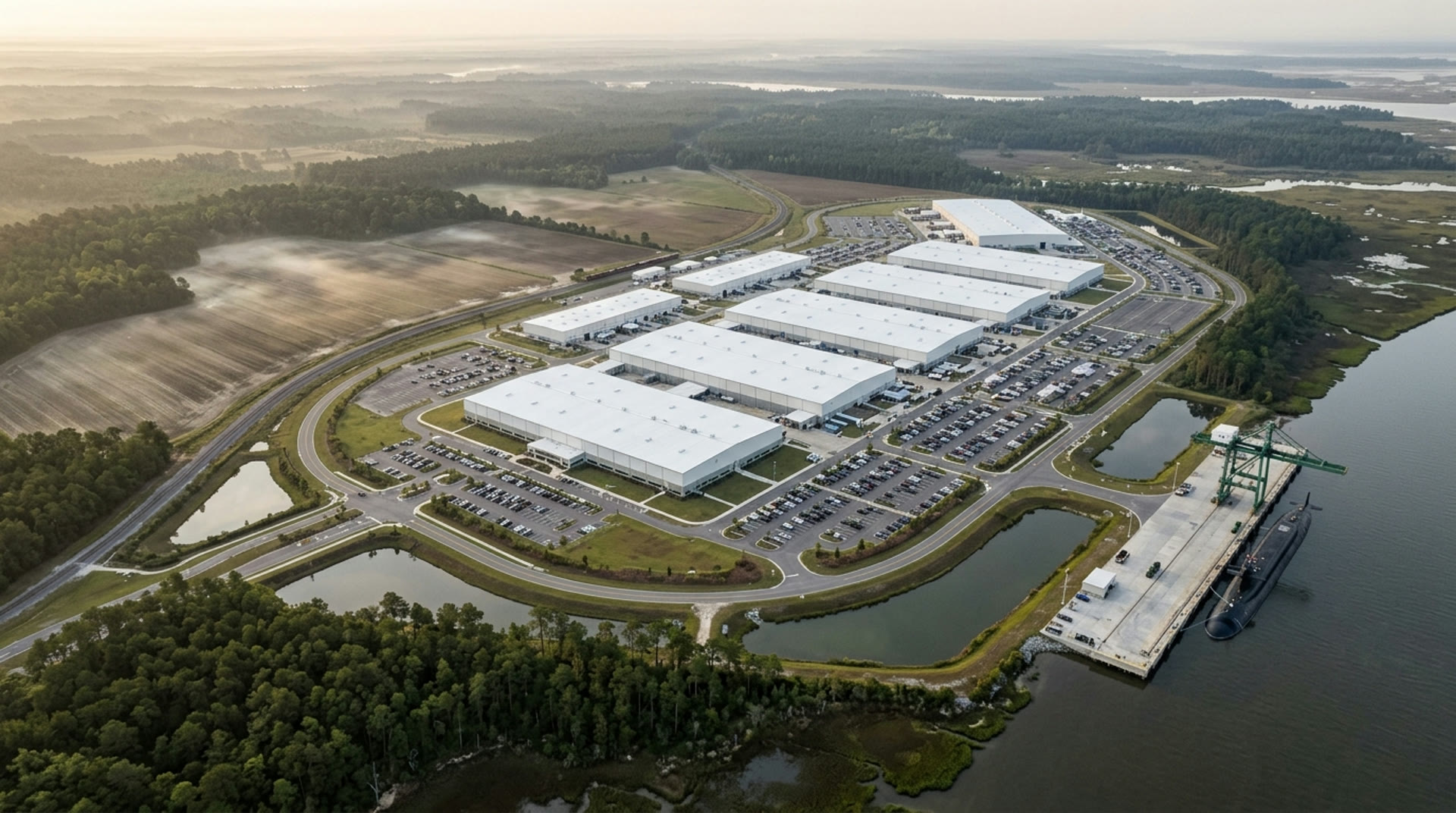
Sea · MUSV-4 · Medium Autonomous Surface Vessel
Styx
An arsenal ship, not an attack craft. It launches and recovers aircraft at sea, so the magazine regenerates instead of emptying.
Mission
BansheePut ordnance, sensors and a launch-and-recovery deck on a hull cheap enough to lose, in enough places at once that no single one is worth a missile.
One STYX is a picket, and that is not the point. Six STYX on a 240-nautical-mile barrier at forty-mile spacing, each holding eight BANSHEE and four POLTERGEIST-150, is 48 interceptors and 24 cruise missiles distributed across 240 miles of ocean with no node worth a missile. The magazine is the formation, not the hull.
There is also a systems reason this ship exists that has nothing to do with weapons. In the maritime domain the surface vessel is the gateway — the only node that can hold a satellite link, an aircraft datalink and an acoustic link to something submerged at the same moment. Without a surface vessel, an undersea picture stays undersea. STYX is the boat that carries the sea domain's data across the surface, and while it is doing that, it is also an arsenal.
Parameters
| Class | Medium autonomous surface vessel — arsenal configuration |
|---|---|
| Length overall | 62.0 ft / 18.90 m |
| Beam | 21.8 ft / 6.65 m — wave-piercing aluminium catamaran, B/L 0.35 |
| Draft | 4.6 ft / 1.40 m hull; 6.2 ft with the transducer trunk lowered |
| Lightship | 31.4 t — 5083/5383 marine aluminium |
| Full load | 48.6 t — fuel 9.6 t, payload 6.4 t, stores 1.2 t |
| Clear mission deck | 46.2 m² between the hulls, 4.9 t/m² over the strong points |
| Mission cells | 12 × quarter-TEU (1.2 m cube) on a 1.25 m rail grid, each with 28 VDC, 400 VAC and fibre |
| Sprint speed | 28.0 kt on 2 × 720 kW MTU 8V2000 M96 |
| Loiter speed | 4–11 kt on a 40 kWe genset driving a 65 kW PTI motor, mains declutched and cold |
| Silent approach | 5 kt for 45 min on a 210 kWh LFP pack |
| Fuel-limited range | 6,400 nm at 8 kt |
| Certified unattended endurance | 60 days — set by machinery run certification, not by tankage |
| Sea state, transit | SS4 at any speed; SS6 at 12 kt |
| Sea state, survival | SS8 / 12 m significant wave height, unattended autonomous heave-to |
| Sea state, BANSHEE recovery | SS4 routine; SS5 with roughly a 30 % wave-off rate. Launch SS5. |
| Sea state, SHADE ops | SS5 |
| Sensors | 360° panoramic EO/IR (8 × 5 MP visible + 4 × 640 LWIR, 1.1 mrad), solid-state X-band nav radar 0.8 m, ESM, AIS, two hull hydrophones |
| Comms | REVENANT MESH: line-of-sight optical 40 Mbps at 14 km with zero RF emission; HF and UHF fallback; acoustic modem to submerged nodes; REVENANT LINK to Link 16, TTNT and IBCS |
| Autonomy | REVENANT CORE plus the declarative COLREGS engine |
| Crew | 0 — no accommodation, no galley, no head, no helm station |
| Delivery transit | Autonomous under a filed voyage plan; no delivery crew, no chase boat |
| Boarding provision | Recovery harness and a towing eye. The boat is not designed to be gone aboard at sea. |
| Unit cost target | $9.4M at rate |
| BANSHEE-M / -R | 8 — six in the magazine, two in deck cells |
|---|---|
| SHADE-M / -R | 24 in two 12-round tube launchers |
| POLTERGEIST-150 | 4 canisters in deck cells |
| TIDEWALL nodes | 12-node laying spread, over-stern chute |
| Launch | 1 × 2.4 t uncrewed surface tender and davit — laying, recovery and inspection |
| Autonomous weapon station | 1 × 30 mm, bow cell — cued by the boat, released under LEDGER-signed authorization |
| Reconfiguration | Under 4 h pierside on the rail grid |
Landing an aircraft on a 62-foot boat
01 · The problem
BANSHEE's entire economic argument is that if it does not engage, it comes back. That argument evaporates if it can only come back to a pier.
Recovering a VTOL onto a 62-foot boat in sea state 4 means putting it on a deck that is heaving 1.4 m, rolling 8 degrees and pitching 5, with a deck-relative closure that has to be resolved in the last two metres. "Land on the deck and hope" does not survive a real Pacific afternoon.
02 · Compensate the deck
A 3.2 × 3.2 m six-degree-of-freedom Stewart platform is set into the mission deck: ±0.90 m of heave authority, ±12° roll, ±8° pitch, 380 mm/s actuator slew, closed at 200 Hz on the vessel's own motion reference unit. In sea state 4 it holds the landing surface to ±0.6° and ±80 mm. It weighs 2.1 t and draws 22 kW peak, 3 kW average.
Feed-forward matters more than the actuators. A hexapod chasing measured motion is always one phase behind the sea. A hexapod driven by a 1.1-second wave prediction from the forward-looking X-band radar and the motion reference unit stays ahead of it, and 1.1 seconds is enough.
03 · Capture, don't land
At the centre of the platform is a 1.1 m compliant capture ring with four claws. BANSHEE flies a 1.5 m/s descent to a three-metre relative hover on relative GNSS and an optical fiducial pattern, then commits. On weight-on-skids the claws close in 220 ms.
The aircraft is never asked to make a soft landing on a moving surface. It is asked to be inside a 1.1-metre circle for a quarter of a second. That is a far easier problem, and it is the one the whole deck is designed around.
The platform then indexes down through a deck hatch into a magazine and service bay, where a two-axis manipulator swaps the battery, refuels, and re-arms from a 12-round effector rack. Nine minutes, unattended.
04 · Where it stops
Recovery is sea state 4 routine and sea state 5 with roughly a 30% wave-off rate. Launch is sea state 5. Above sea state 5, STYX is a sensor and a communications node, not an airfield, and the BANSHEEs it launched had better have somewhere else to go.
COLREGS is a legal problem, not a path-planning problem
Collision avoidance is not path planning. It is a legal problem with a path-planning component, and treating it as the former is why unmanned surface vessels are still shadowed by a chase boat with a licensed mariner aboard.
Rules 13 to 17 — overtaking, head-on, crossing, give-way action, stand-on action — are geometry, and geometry compiles. Rules 2, 5, 6, 7, 8 and 19 are judgement, and judgement is what gets litigated. The worst of them is Rule 17, which requires the stand-on vessel to act when it becomes apparent that the give-way vessel is not taking appropriate action. That is a machine deciding a human mariner is failing, and then overriding him. There is no way to write that rule without writing an opinion.
So we sign the opinion. The COLREGS engine is a declarative rule set inside REVENANT CORE, and every avoidance manoeuvre is LEDGER-signed together with the contact picture that justified it. After an incident the investigator receives a signed, replayable record: which contacts were held, at what CPA and TCPA, which rule the engine believed governed, the moment it concluded the give-way vessel was not acting, what it did, and what the alternatives it rejected would have cost. No other USV can produce that record, and it is the only way a flag state, an insurer or an admiralty court can treat an unmanned vessel as anything other than an unattributable hazard.
| Rule 5 — look-out | Panoramic EO/IR detects an unlit 6 m hull at 2.9 km and a floating container at 900 m. Radar holds a 5 m² target at 8 nm in SS3. And two hull hydrophones — Rule 5 says "by sight and hearing", and we hold ourselves to both halves of it. STYX hears a fog signal and an approaching screw. |
|---|---|
| Rule 3(g) / Rule 18 | While operating BANSHEE the vessel is restricted in her ability to manoeuvre, and displays the lights and day-shapes that say so. That is not decoration — under Rule 18 it obliges power-driven vessels to keep clear while the deck is hot. |
| Rule 8(b) — manoeuvre policy | Large and early: a 30° course change at 6 nm, not a 5° nudge at 2 nm. An alteration must be "readily apparent to another vessel observing visually or by radar." A mathematically optimal micro-correction is legally indefensible and illegible to the mariner it is aimed at. We give up efficiency to be readable. |
| AIS and running dark | AIS receives always and transmits by default. Going dark is a commanded state entered only on a LEDGER-signed authorization naming the human who ordered it and the window it is valid for. |
| CPA envelope | 0.5 nm open ocean · 200 m in a traffic separation scheme · 60 m in a harbour approach at 6 kt or less |
| Acceptance gate | Zero COLREGS violations across 14,000 nm of witnessed trials in Class A and B traffic, adjudicated by licensed masters reviewing the signed record |
CONOPS
Phase 01 · Sortie
Any pier, any well deck, under its own power
No launch equipment, no crane, no mother ship. The mission deck is reconfigured pierside in under four hours on the rail grid, which means the boat that sailed as a counter-UAS picket comes back as a seabed-laying platform without going near a shipyard.
Phase 02 · Transit
8 kt on the loiter drive, mains cold
AIS transmitting, lights and shapes correct, COLREGS engine holding a half-mile CPA envelope. 6,400 nm of fuel available; 60 days certified. The main engines are not started for a transit — running a 720 kW diesel at 26 horsepower destroys it, which is the entire reason the loiter drive exists.
Phase 03 · Barrier establish
Phase 04 · Persistent watch
Radar, EO/IR, ESM, passive acoustic — fused and signed
Every contact goes into one barrier-wide picture, hash-chained at the edge. SHADE is launched for close-look identification of contacts the radar cannot resolve, at four pounds a copy.
Phase 05 · Engage
On a signed token, and any hull can shoot on any hull's track
BANSHEE against air and cruise threats, POLTERGEIST against surface and land targets. Engagement authority is a LEDGER capability token that is issued once and consumed once — there is no ambiguity about who authorized a shot and no mechanism by which two hulls service the same target twice. Unexpended BANSHEEs come home to the compensated deck and regenerate a sortie in nine minutes.
Phase 06 · Sustain
Any vessel with a five-tonne crane
Deck cells are replenished at sea from whatever is available, or the boat returns to any pier. There is no specialised tender in this concept, because a specialised tender is a coordinate and a single point of failure.
Phase 07 · Withdraw or scuttle
It is a $9.4M object
If the boat cannot be recovered, its data has already gone out over the mesh and the hull is scuttled on a signed authorization. Nothing about the campaign plan depends on getting any particular hull back.
Why it is built this way
The mission deck is the product, and the mission deck is why this is a catamaran. A 62-foot monohull gives roughly 22 m² of usable working deck. A wave-piercing catamaran of the same length gives 46.2, because the deck spans the tunnel. It also has far better roll behaviour in short seas — which is what actually governs whether you can land an aircraft on it — and two widely separated shaft lines, so a single-engine casualty is a limp-home rather than a tow.
Everything else follows. The hybrid drivetrain exists because a 60-day boat cannot run its sprint engines at 4% load. The wave-compensated platform exists because reusability is worthless if the aircraft can only come home to a pier. And the COLREGS engine is declarative and signed because an unmanned vessel that cannot explain itself after a collision will never be allowed out of sight of a chase boat.
What is hard, stated plainly
| Unattended machinery reliability | This is the whole program. A crewed boat has an engineer who notices a weeping seal at 0300. Sixty unattended days means the boat diagnoses itself — 340 sensed points and a vibration-signature model per rotating machine. First-year MTBCF target is 1,400 h. The mission needs 2,600 h. We are not there and we know exactly how far. |
|---|---|
| The compensated platform | 2.1 t of hexapod exposed to green water, salt and thousands of cycles per deployment. The failure mode is graceful — it locks level and reverts to a fixed deck — but recovery then drops to SS2 and BANSHEE's reusability argument collapses with it. |
| Not self-righting | Stated above rather than engineered around. |
| Fouling | Sixty days at 6 kt in warm water costs about 22 % of speed by day 60 in the Gulf. Foul-release coating helps. A hull-crawler would fix it. We have not built the crawler. |
| Regulatory | Flag-state and classification treatment of a 48 t unmanned vessel is unsettled. We build to ABS autonomous-vessel guidance and DNV's ARV rules and fully expect both to change underneath us mid-program. |
| Weapon release policy | Whether an unmanned surface vessel may fire in peacetime waters is a policy question we do not get to answer. The LEDGER token architecture is built to make it answerable. That is not the same as answered. |
Related systems
All sea systemsGovernment & Primes
Request a STYX briefing
Mission-deck interface control documents, the COLREGS engine's rule set and trial adjudication plan, and barrier-concept modelling are available to US government customers and allied ministries of defence under an executed agreement.
Request a briefing programs@fantom.aero
Every figure on this page is a design target derived from first-principles analysis, not a trial result. STYX is in detail design; sea trials are planned for 2029. No export-controlled information is published on this site.