
Knell
Non-kinetic counter-swarm effector — KNELL-F fixed, KNELL-M mounted
Every other effector services a target. KNELL services a volume of airspace — and signs what was inside it.
In design
Mission
A raid is not a lot of targets. It is one target with a shape.
Defeat a saturating unmanned raid over a defended asset without expending a round, at a rate that does not fall behind the arrival rate.
A counter-UAS architecture that engages one airframe at a time has a throughput ceiling, and above that ceiling it does not matter how good any single engagement is. Forty airframes arriving in ninety seconds against a node that services targets sequentially is an arithmetic loss the moment the raid launches. The defence does not fail on hit probability. It fails on rate.
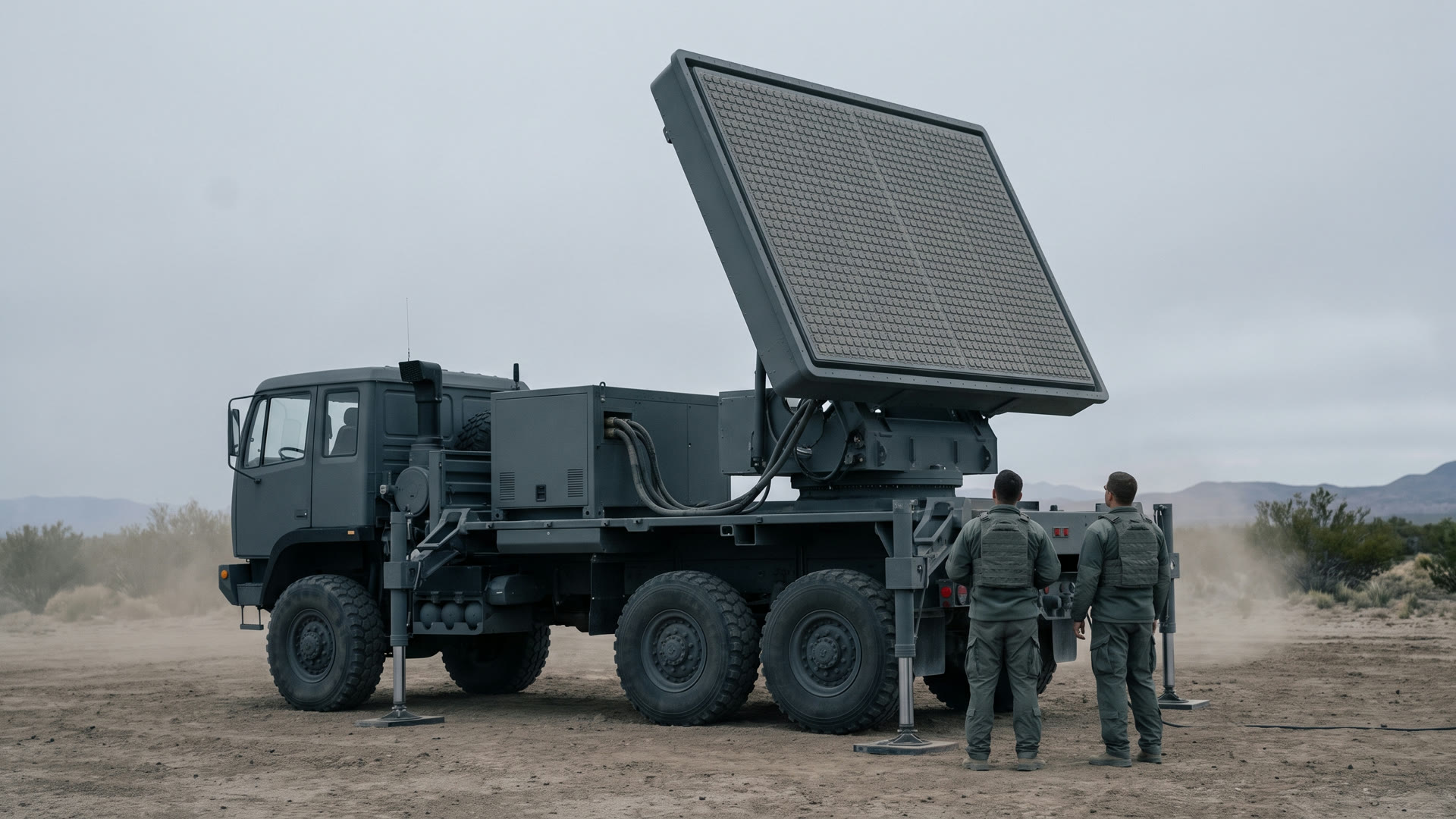
KNELL removes the per-target step. A composite burst from a 3,840-element solid-state aperture puts enough field strength across a 45° by 20° cone to upset every unshielded flight controller inside it — forty to sixty airframes at once, in a single 4-second cycle, for about a dollar. The engagement is not resolved against a track. It is resolved against a volume.
That is also the whole problem with it, and this page spends more words on the problem than on the capability. A weapon aimed at a volume affects everything in the volume, the volume is invisible, and nobody outside the node can see what was in it. Which is why the record matters more here than anywhere else in the arsenal.
Key figures
Concept film
Nothing is fired
Concept film · 0:05 · silent
There is no beam to photograph and no flash to cut to. A microwave burst is invisible, and the only externally observable event is that the airframes stop flying. Nothing here is a record of a test. No KNELL has been built and no aperture has been fired — the emitter, the raid and the effect are concept renders made to communicate design intent.
The argument
Rate, not probability
The comparison that matters is against our own ladder. CAIRN already carries a high-power microwave rung; KNELL exists because that rung is sized to a node, not to a raid.
| Sequential engagement, any effector | Throughput is set by slew, lock, authorise and assess — call it 2.3 s a target at best. Thirty-nine engagements is ninety seconds of continuous work and the raid has already arrived. The last airframe is serviced after it has done what it came to do. |
|---|---|
| CAIRN — rung 1, HPM | 900 m in a 25° cone, 8–14 airframes a burst, 8 s recharge. Three bursts service the cone and the gun mops up outside it. Correct for a node defending itself and it is why the rung is on the turret. |
| KNELL | 2,400 m in a 45° × 20° cone, 40–60 airframes a burst, 4 s recharge. One burst covers the raid front. Two covers it again at the far edge. The aperture is 6.0 × the area and the prime power is 3.2 × — that is the entire difference, and it costs a dedicated vehicle to carry it. |
| Cost of the raid | Two composite bursts. $2.20, and 8 seconds. Against forty airframes that a sequential architecture cannot clear inside the arrival window at any price. |
| What that number is not | It is not a claim of forty kills. At 1,200 m the single-burst upset probability against unshielded commercial Group 1 is 0.82; at 2,400 m it is 0.41. Two bursts at the near edge leaves you expecting one or two airframes still flying, and those are the ones another rung has to service. |
| Unshielded commercial, 1,200 m | 0.82 |
|---|---|
| Unshielded commercial, 2,400 m | 0.41 |
| Fibre-tethered, 1,200 m | 0.79 — the tether defeats jamming, not this |
| Hardened bus, short cable runs, 1,200 m | 0.15 — three bursts and it may still be flying |
| Group 3, metallic airframe, 1,200 m | 0.06 — KNELL is not the answer to this target |
Architecture
Silent until it is not, and then it must move
Shoot and displace
KNELL carries no search radar and emits nothing on watch. The instant it fires it becomes the brightest emitter for a very long way, and it has to leave.
This is not a signature we can engineer away, and we are not going to present it as a detail. A several-hundred-kilowatt burst radiates well outside the main lobe. A capable ESM receiver can detect and coarse-locate a KNELL burst at roughly 40 km — about sixteen times the range at which KNELL is effective. The weapon announces its own position to a far larger audience than the one it engages.
So the architecture is built around the consequence rather than around the emission. KNELL sits cold on REVENANT MESH, cued by a VIGIL tower kilometres away, with nothing of its own radiating. It fires. Then it displaces — KNELL-M is stowed and rolling in 90 seconds, and that number, not the burst, is what makes the mounted variant the primary one. KNELL-F exists for sites where displacement is impossible and the answer has to be hardening, dispersal and accepting that the emplacement is known.
Search is off-board for the same reason it is off-board on CAIRN: a node that searches is a node with a published position, and KNELL cannot afford to publish twice.
| Array | 2.4 × 1.6 m, 3,840 solid-state amplifier modules. No vacuum tube, no single-point RF failure — module attrition degrades gracefully. |
|---|---|
| Cone | 45° azimuth × 20° elevation instantaneous, electronically steered ±45° off boresight without moving the positioner |
| Composite burst | 340 kJ to the array, sub-millisecond, frequency-agile across the band to cover unknown coupling paths |
| Recharge | 4.0 s to full, 1.4 s at reduced fill for a follow-on inside the same cone |
| Positioner | 360° continuous azimuth, −5° to +85° elevation, 60°/s. Coarse pointing only; the cone is steered electronically. |
| Graceful degradation | Ten per cent of modules dead costs about 0.9 dB of field strength, not an outage |
| The problem | A composite burst pulls over a megawatt for under a millisecond. No tactical generator on earth serves that load; it is a pulse problem, not an average-power problem. |
|---|---|
| The answer | A 150 kWh LFP buffer and a pulse-forming network between the generator and the array. The generator sees a smooth 20–40 kW charging load and never sees the pulse. |
| Prime power | 400 kW tactical generator, or vehicle power take-off on KNELL-M |
| Generator off | 210 bursts, or 60 h of silent watch at the 1.6 kW watch load — thermally cold and acoustically silent with a full magazine |
| Magazine | Unlimited while fuelled. There is nothing to resupply and nothing to run out of. |
Auditable autonomy
The cone is invisible. The record is the only evidence it ever existed.
Every other engagement in the portfolio leaves physical evidence. This one leaves nothing but a signed block, which makes the block the product.
After a gun engagement there are casings, fragments and a hole. After a KNELL burst there is a volume of air that briefly had a strong field in it and forty airframes on the ground with no visible damage. If a civilian aircraft, a hospital's telemetry or a partner nation's unmanned system was inside that cone, there is no physical way to establish it after the fact. Either the node recorded the geometry or the question is permanently unanswerable.
So REVENANT LEDGER signs the cone itself: boresight and steer angles, the beamwidth solution, the fill fraction, the survey-grade position and attitude of the aperture, the modelled field-strength contour to the −20 dB edge, the full friendly and civil track file as held at the instant of fire with its age, every keep-out volume loaded at emplacement, and the authorising identity. One block, before the burst, not after.
That last detail is the one that matters. The block is written and signed before the pulse-forming network discharges, so the record cannot be a reconstruction of a decision — it is the decision. A record assembled afterwards is a statement about what someone believes happened, and in front of a board of inquiry that is worth very little.
Specification
Parameters
Design targets, not measured results, unless the line says otherwise.
| Chassis | 6 × 6 tactical, 19,500 kg GVW at combat weight |
|---|---|
| Effector module mass | 4,900 kg — array 1,640; pulse-forming network 900; buffer 1,050; positioner 780; structure and cooling 530 |
| Halt to ready | 90 s — four outriggers, level, gyrocompass, geo-register |
| Ready to rolling | 90 s. This is the number the design is actually built around. |
| Firing on the move | No. Pointing and survey accuracy both require the outriggers down. |
| Transport | Road, rail, C-17. Not a CH-47 sling load — the module is over the hook. |
| Crew | Two. Neither is required for the engagement. |
| Footprint | One 20 ft ISO for the effector on an armoured pedestal, plus a 6 m power skid |
|---|---|
| Emplacement | 22 min, two people, from a flatrack |
| Pedestal | 2.1 m armoured steel, revetted. Raises the aperture over near-field clutter and berms. |
| Unattended endurance | 21 days on the skid and a folded solar array at the watch load |
| The accepted condition | A fixed emplacement that has fired once is a known emplacement. Hardening and dispersal are the mitigation; there is no technical fix. |
| Environmental, both | −40 °C to +55 °C. Unaffected by fog, rain, dust and marine haze — the one thing this effector has over an optical one. |
| Unit cost target | $6.2M at 80/yr from FORGE-1 |
| Cue over MESH | 18 ms from a VIGIL tower |
|---|---|
| Cone solution | 260 ms — on the node, no network. Raid front fitted, steer angles and fill computed, keep-out volumes and the friendly track file differenced against the cone. |
| Positioner slew, worst case | 3.0 s from 180° off. Usually far less, because the cone is steered electronically. |
| Human authorisation | Required by default. 1.5–4 s. |
| LEDGER block signed | Before discharge, always. 40 ms. |
| Cue to effect, authorised | 5.2 s. The human is the long pole and we are not going to pretend otherwise. |
| Raid mode | Above a raid-size threshold, burst authority may be pre-delegated for the duration by explicit signed ROE — time-boxed, cone-bounded, and closed automatically when the raid ends. Delegation never widens the cone or the keep-out set. |
| Assessment | Off-board. KNELL cannot see what it did; the cueing tower reports which tracks stopped manoeuvring, and that assessment is signed as the tower's, not the node's. |
Concept of operations
Six phases
-
Phase 01 — Emplace
The keep-out volumes are signed, not configured
Halt, outriggers, level, gyrocompass, geo-register, join the VIGIL battery on MESH. The ROE for this position — the elevation floor, the azimuth sectors locked out by an airway or a town, the maximum fill — is loaded and signed at emplacement. It is not a runtime setting anybody can quietly widen.
-
Phase 02 — Cold watch
Emitting nothing at all
VIGIL searches. KNELL listens on the mesh with no radiated emission of any kind, no generator running, 60 hours on the buffer. Nothing about the position is observable.
-
Phase 03 — Cone solution
Fit the raid, not the target
Tracks cross threshold at a tower kilometres away. CORE fits a cone to the raid front, computes steer and fill, and differences it against every keep-out volume and the friendly and civil track file — carrying the age of that file into the decision. 260 ms.
-
Phase 04 — Authorise and burst
Signed before it discharges
The cone geometry goes to the authorising human as a volume, not as a target count. On authorisation the block is written and signed, and only then does the pulse-forming network discharge. Externally: nothing. The airframes stop flying.
-
Phase 05 — Displace
Ninety seconds
The burst was detectable at roughly forty kilometres. KNELL-M stows and is rolling in 90 s, and the plan assumes counter-battery. This phase is why the mounted variant is the primary one and the fixed one is the exception.
-
Phase 06 — Reconcile
Publish what was in the cone
The tower's assessment, the signed cone and the track file are reconciled after the fact into one exportable artefact. If something was inside the volume that should not have been, that finding comes from our own record — which is the only way anyone will ever know.
Engineering rationale
Why it is built this way
A dedicated node, not a bigger rung
The aperture that services a raid front is six times the area of the one that fits on a shared turret, and it needs 3.2 × the prime power. That does not retrofit onto a multi-effector mount. The tradeoff: a whole vehicle and a whole crew committed to one effector that does exactly one thing.
Solid state, no tube
3,840 amplifier modules degrade gracefully — ten per cent dead costs 0.9 dB, not the system. The tradeoff: a tube would be cheaper and more compact per joule, and we accepted cost and volume to remove a single point of failure from a weapon that only gets one chance per raid.
Mounted is the primary variant
Because the burst is detectable at sixteen times its effective range, the design problem is not the shot, it is the ninety seconds after it. The tradeoff: a chassis, a road-mobility requirement, and a fixed variant that is honestly the weaker of the two.
No search radar
Search comes from a VIGIL tower over MESH. A node that searches has already published its position, and KNELL cannot afford to publish twice. The tradeoff: mesh-isolated, KNELL has no organic cue at all — it is a weapon with no eyes, and it says so rather than carrying a token sensor that pretends otherwise.
The block is signed before discharge
A record written after an invisible engagement is a reconstruction. Written before, it is the decision itself. The tradeoff: 40 ms of latency inside the fire-control loop, and a hard requirement that the cone solution be complete and serialisable before the weapon is allowed to act.
Assessment is somebody else's job
KNELL cannot observe its own effect, so it does not claim one. The tower reports which tracks stopped manoeuvring and that assessment is signed as the tower's. The tradeoff: mesh-isolated, there is no assessment at all, and the operator is firing into a volume with no feedback.
Program candor
Open engineering risks
- It is the loudest thing on the battlefield the moment it fires. A burst is detectable and coarsely locatable at roughly 40 km, against an effective range of 2,400 m. There is no version of this weapon that is quiet. Everything about the design is a response to that fact rather than a solution to it, and a customer who cannot displace should read the KNELL-F line as the compromise it is.
- The cone is not selective, and it is invisible. Every unshielded electronic system inside it is affected — friendly unmanned aircraft, an unhardened vehicle bus, a comms relay, civilian avionics, medical telemetry. CORE differences the cone against the friendly and civil track file, but that file is only as good as its last update, and in a mesh-denied fight it is stale. This is the effector most likely to be locked out by ROE, and it should be.
- Upset is not removal. Forty airframes that stop flying are forty masses on ballistic trajectories with whatever they were carrying. The debris footprint of a cleared raid is a real ground-safety problem and it is the reason the system is commonly locked out over populated ground — which is precisely where the raids will be.
- Probability of upset is statistical and aspect-dependent. Coupling depends on aperture geometry, internal cable runs, shielding and the airframe's attitude at the instant of the burst. We publish a curve because a single number would be dishonest, and a hardened target at 0.15 means three bursts may not be enough.
- Effect verification is the hardest unsolved problem on this program. The weapon cannot see what it did, the effect leaves no signature, and the assessment comes from a third node. Proving to a customer's satisfaction that a burst worked — or that it did not touch something it should not have — is a test-and-evaluation problem we have not yet solved, and it is a bigger schedule risk than the array.
- Spectrum authority may be the binding constraint, not physics. A wideband high-power burst is a licensing and host-nation problem before it is an engineering one. There are training ranges where this system cannot be exercised at full fill, and that limits how much measured data will exist before first fielding.
Related
What cues it and what it does not replace
KNELL-F
Where displacement is not an option
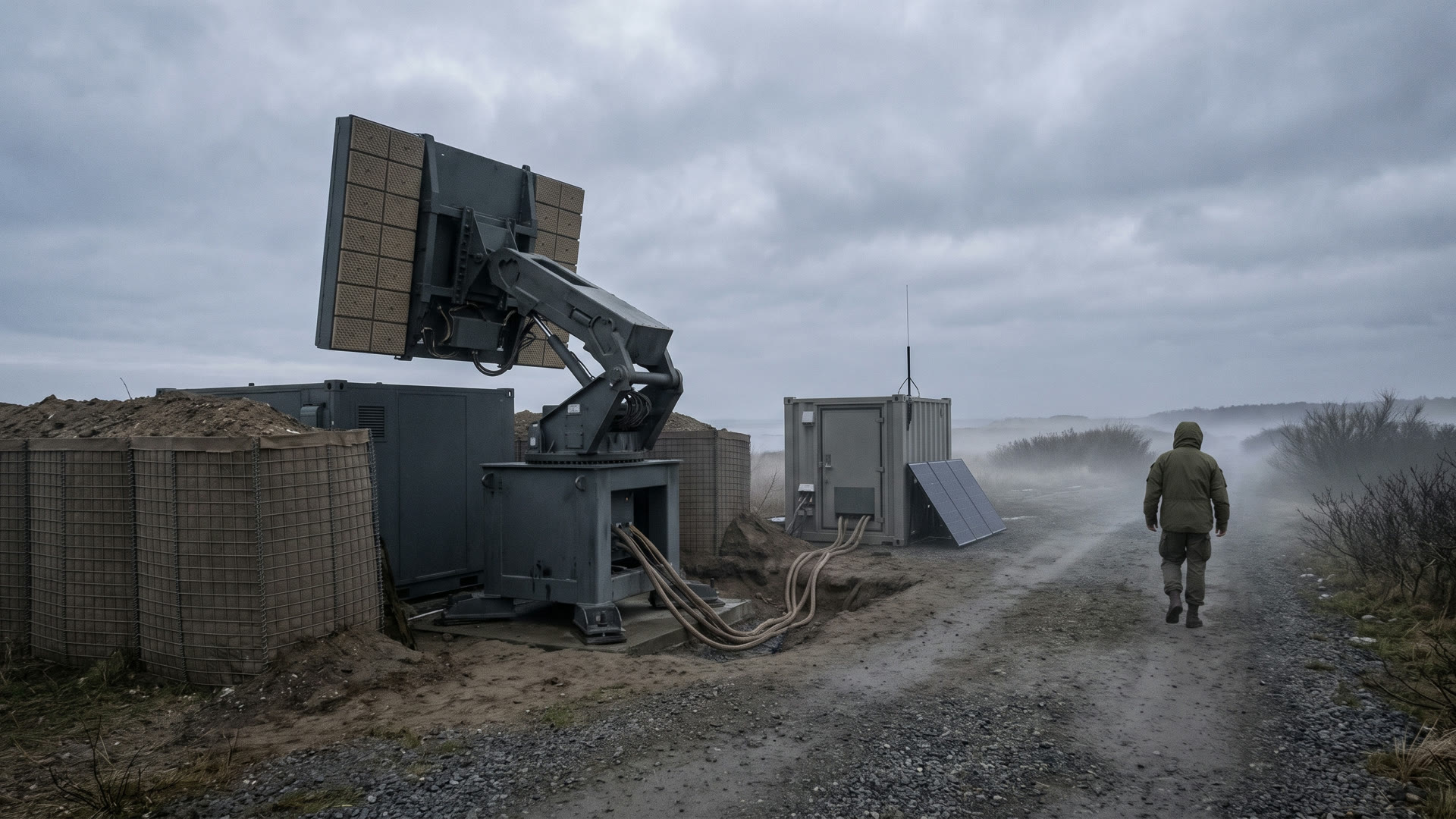
Concept render · KNELL-F
A pier, a fixed airfield, a substation. The emplacement is revetted, the power module is separate and buried to the cable trench, and 21 days of unattended watch come off the skid and a folded array. It is the weaker variant and we will say which one we would site.
Contact
Bring us the raid, the airspace and the spectrum authority
Send us the raid profile, the airframes you expect to face, the keep-out volumes over your site and what your spectrum authority will actually permit. We will model the cone against it and give you a clearance rate — including the sites where the keep-out set is large enough that a volume weapon is the wrong answer and we will tell you to buy something else of ours.
Every figure on this page is a design target derived from first-principles analysis, not a measured result. No KNELL has been built, no aperture has been fired, and no upset probability on this page has been measured against a real airframe. Where a number here is later measured and comes out worse, we will publish the measured number. No export-controlled information is published on this site.